
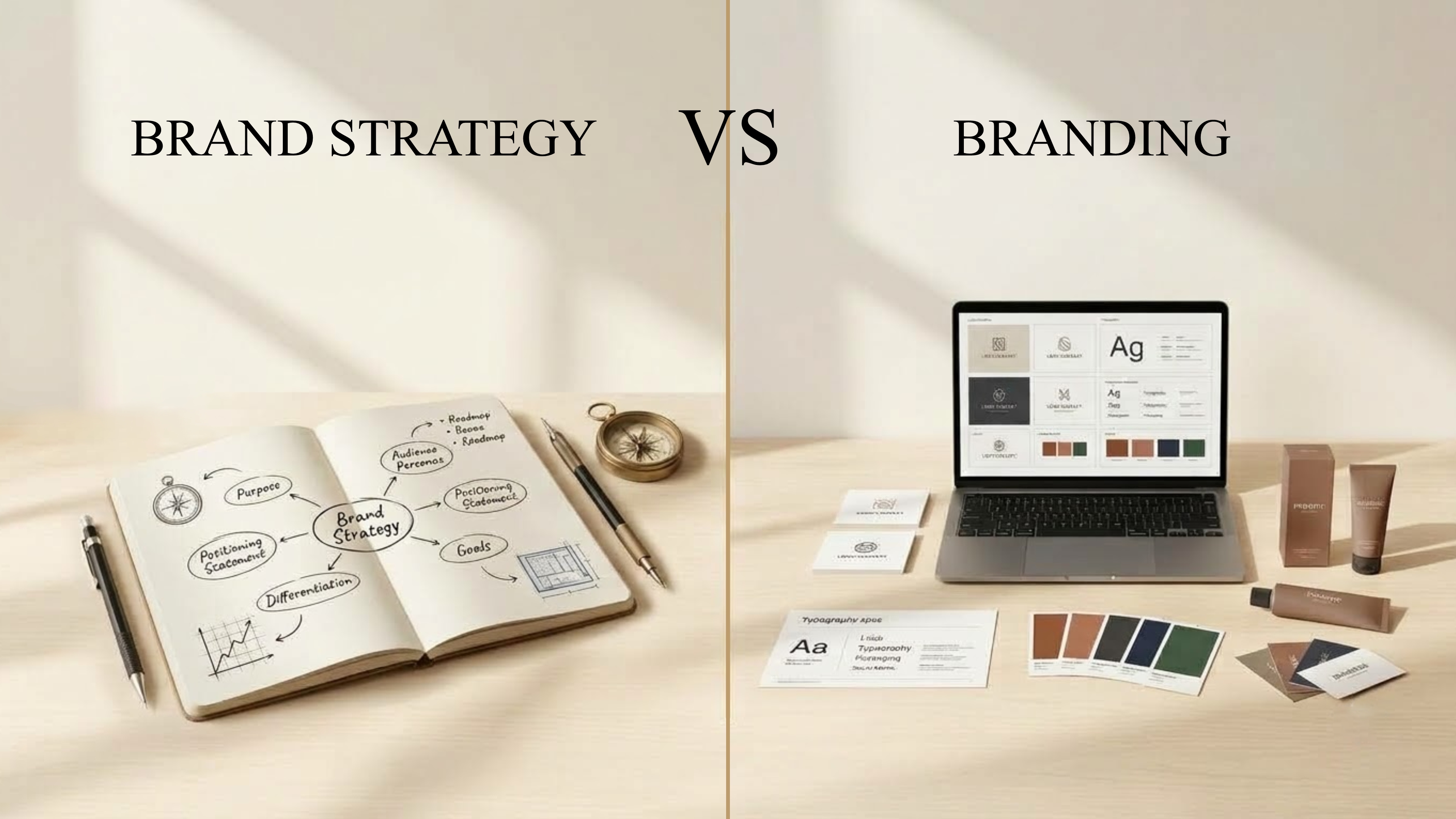
When building a business, terms such as branding, brand strategy, brand identity, and brand positioning are often used interchangeably. But, these are not the same things.
A business can have an attractive logo, interesting colors, a great website — and still have a hard time establishing a position in the marketplace. That is because visual branding is only one side of the coin.Understanding the difference between brand strategy vs branding will help the company to plan the brand presentation, communicate with the customer, and build recognition.
But what is the difference between branding vs brand strategy, and which one does your business need?
Let’s find out!
What Is a Brand Strategy?
A brand strategy is a strategy or plan that defines what the brand should be. Think of a brand strategy as one part of the brand building process with the primary focus on direction.
Before you decide who your brand should be visually, it’s critical to know why it exists and where it wants to go.
A brand strategy typically includes elements such as:
Brand purpose and vision
Target audience
Customer needs and motivations
Knowledge of the market and competitors
Brand positioning
Brand personality
Brand values
Value proposition
Messaging and communication direction
Differentiation
For example, take two cosmetic companies offering premium skincare. Each might have its unique packaging, photography styles, and target markets, which influences brand strategy.
Their visual branding might be completely different since they appeal to different customer segments and offer various benefits.
In other words,
brand strategy decides what a brand should be.
What Is Branding?
Branding is the process of shaping and designing that defined direction so that it can be presented to the world. It focuses on creating a specific image, impression, and recognition.
It is the realization of the strategy, and what people see and experience when they interact with your business. It is more known as brand building.
Branding can consist of elements such as:
Logo design
Brand colors
Typography
Packaging
Photography style
Website design
Social media visuals
Brand voice
Marketing materials
Advertising
Brand touchpoints
This is where identity is critically important, which is a collection of characteristics and traits that make a brand recognizable and different from others.
It consists of elements such as logo, colors, typography, imagery, voice, and many other visual and verbal features.
If brand strategy answers “what should we stand for?”, branding defines “how do we express it?”
Brand Strategy vs Branding: The Main Difference
One of the easiest ways to describe the difference between brand strategy vs branding is to think of a building.
Brand strategy is a blueprint, while branding is the architecture and design that builds upon the blueprint.
A blueprint dictates the purpose and direction of the building, so the design will shape the blueprints into a realized project with defined characteristics.
In other words, your brand strategy defines the direction, while branding builds upon it to create recognition.
Defines direction Expresses the direction
Focuses on positioning Focuses on perception
Defines the target audience Communicates with the audience
Defines differentiation Makes differentiation visible
Defines messaging Applies the message
Where Does Brand Positioning Fit In?
Brand positioning is one of the critical aspects of a brand strategy that defines the space a business wants to occupy in the minds of the customers against the competitors.
A great positioning answers questions such as:
Who are we for?
What do we offer?
Why should customers care?
What makes us different?
For instance, a generic statement that the company sells coffee will not provide valuable positioning, but a strategy that defines the brand around specialty coffee, local products, or a quick urban experience will give the audience reasons to choose and remember the brand.
Positioning should be the basis for your messaging, as well as visual identity, products, customer experience, and marketing.
That is why branding a brand before establishing proper positioning might lead to having pretty pictures and logos with unclear direction.
How Brand Identity Connects Everything
With a defined strategy, your brand identity will help bring the direction to life through recognizable design and communication.
Let’s say that the strategy defines the brand as innovative, friendly, and technology-driven.
Your brand identity might incorporate some of these characteristics through a modern logo and simple typography, contemporary color system, and clean digital interfaces, messaging, photos, and other graphics.
The point is that these elements should not be random, but rather define the strategy so that your brand has a specific character.
Which is again, the difference between designing a logo and building a recognizable brand identity.
What Is a Branding Strategy?
The term branding strategy can be confusing, and it sometimes overlaps with brand strategy.
In practice, it defines how the company should build and execute its brand building efforts. It usually sits between the high-level brand strategy and brand execution.
It can dictate things such as brand positioning, communication strategy, brand voice, language and style guides, campaigns and promotions, and consistency building across the board.
Depending on the context, a branding strategy can overlap with brand building, execution, or strategy itself.
But, the reality is that the name is not as important as actually defining the strategy.
Does Every Business Need Brand Strategy?
Yes. But, it can vary from company to company.
A small local business may not need a detailed brand strategy, but they should have an understanding of who their customers are, what they offer, why they should choose this particular business, how they want to be perceived, and how they are different from competitors.
A growing company may need a broader strategy, especially as it expands, launches new products, or changes its positioning.
Without a strategic approach, businesses can easily be all over the place and lack consistency.
One ad campaign promotes a luxurious experience, while the website looks casual, and the social media posts communicate something entirely different.
When Does Your Business Need Branding?
A brand typically needs branding when it wants to build awareness and recognition.
Companies need to invest in brand development when they launch a new business, move into a competitive market, reposition an existing company, launch a new product, or need to update an outdated brand identity.
They might need branding to create a consistent digital presence – such as a website or social media.
Companies need branding to be able to communicate effectively with the audience while conveying the intended positioning.
What Should Come First: Strategy or Branding?
Strategy should always come before branding.
Think about it – what would happen if you choose your brand colors, logo, packaging, and social media style before you identify your audience and positioning?
You could potentially have beautiful visuals, but it might not resonate with the audience or convey the intended message.
A strategic process usually looks like:
Research → Brand Strategy outline → Messaging →Positioning→ Brand Identity → Branding → Consistent Execution…
It does not mean that branding is a one-time activity that occurs after strategy.
The company will continue to evolve and so will the branding. Especially as the company grows and the strategies may change.
Brand Strategy vs Branding: What Does Your Business Need?
It depends on the situation. If your brand is unclear about its positioning, audience, differentiation, or messaging – you need brand strategy.
If the strategy is clear, but your business looks like it was built by a group of marketers throwing things at a wall, focus on branding.
If both are lacking — you need both.
The best brands are not focused on separating strategy and branding, but rather connecting them.
Your brand strategy defines what your business should represent, while your branding defines how it should do it.
Final Thought
The discussion around brand strategy vs branding is really about how these two sides of brand building relate to each other.
Your brand strategy defines the destination, while your brand building helps the audience to recognize your journey.
A great brand is not defined by a beautiful logo or a well-crafted strategy document. It builds when the company has a set of valuable strategic ideas that are communicated consistently to the audience to influence their perception and behavior.
So, instead of the company asking, “what should our brand look like?”, it should rather ask, “what should our brand mean to the people we want to reach?”
