
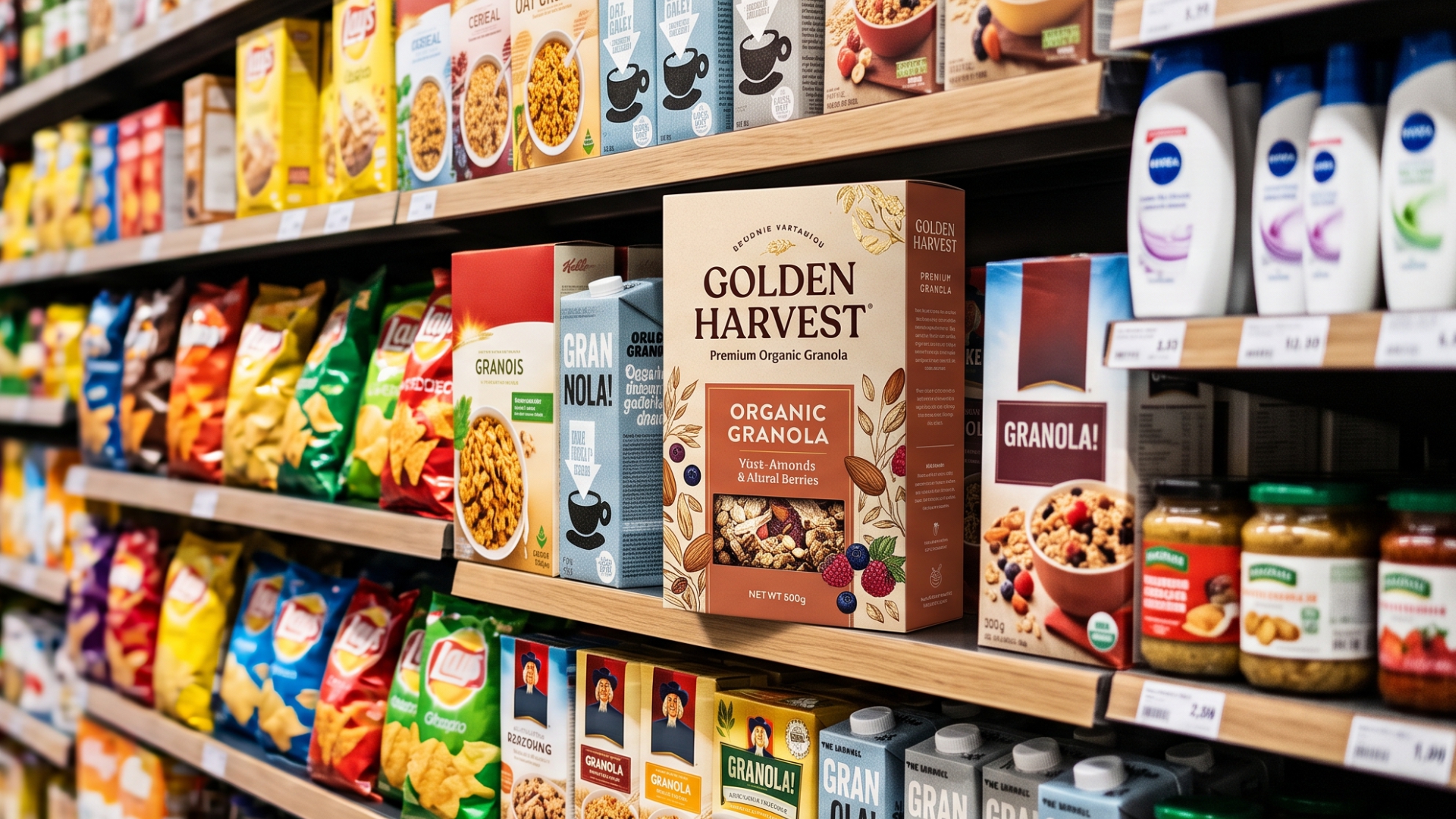
The FMCG world is crowded with biscuits, snacks, beverages, personal care products, packaged foods, household products, and a lot more. All of these products are available on your supermarket aisle and they are competing for your attention. The customer is not buying every package, but they are simply scanning and this is the key challenge for FMCG brands, ‘How do you make a customer notice your product before they begin noticing the competitor's product that is placed just beside it?’
.
FMCG packaging design actually does several jobs at the same time. It attracts the customers, helps your customers to identify what they want, communicate who you are, differentiate as well as persuade them so as to make them buy your products.
The goal of FMCG branding is not to make product packaging as loud as possible, but it is to make it relevant, recognizable, and distinctive enough so that your FMCG packaging design can be picked up by the customers.
The FMCG environment is highly unique. Unlike many high consideration purchases, FMCG buying can happen very quickly, rapidly, habitually, and with limited research. Hence, FMCG packaging design therefore becomes an important point of communication at the moment of purchase.
These product packaging play 3 roles in general. First is to get attention. The FMCG packaging design should be deliberately thought of in a way that it gets the product noticed. Second is to promote FMCG branding to help the customers identify the brand. Third is supporting decision making by letting your product packaging communicate what your product is and why it may be worth choosing.
A product can be excellent and it may still struggle if your customers are not noticing it or understanding it, and hence FMCG branding becomes very important.
A product packaging should not be designed without pre-thoughts. Before designing a product packaging the FMCG brand needs to understand their competitors, category conventions at place, shelf placements, dominant colours, common layouts, price positioning, and visual codes.
The brand needs to look at the actual shelf and do a visual audit. It needs to see what everything looks like and then strategise to find out where the visual gap is. For example, if every competitor is using red or yellow or product photography or large product names, simply copying the same formula will never carry differentiation. But abandoning all these category cues can make the product more confusing.
So in order to differentiate the category without disconnecting from the category, an FMCG packaging design should be slightly different but falling in the same arena. This tends to make a greater shield impact because it makes the customer differentiate your product immediately.
An FMCG branding done right should lead your customers to recognize your brand without reading through everything. An FMCG branding can help to build consistency through the logo placements, brand colors, typography and illustration style. Moreover, using the similar type of graphic elements, packaging architecture and photography can also
make your product packaging look more recognizable.
There are multi SKU points that a brand may use in order to make the product recognizable. For example, if a food packaging design brand sells original spicy cheese and peri-peri flavors, then each variant should have its identity while still clearly belonging to the same family.
Thus, it does not mean that consistency has to be repetitive, or should not even be repetition. In this case, the product packaging range should feel related to the same FMCG brand without becoming visually identical. In this way, an FMCG brand can make shelf impact in India.
Colours are often the first thing that are noticed on a shelf. When you start with your FMCG packaging designing, the colours that you choose should help to communicate your brand identity, product variant, category, its positioning, flavour, as well as the emotional tone. Keeping the shelf impact in mind, a colour that works beautifully on its own might disappear when it is surrounded by similar competitors on the shelf; thus, the FMCG branding needs to evaluate the colour on screen, on the printed pack, and even on the actual shelf.
Secondly, when your product packaging is placed several feet away, what can the shoppers see?
Creating visual hierarchy that makes your product recognisable even from far away should be a part of your FMCG packaging design planning. To design front of the pack hierarchy, you should first highlight the brand, the product name, the variant, the differentiator, and supporting information. However, one should avoid using too many competing headlines, tiny typography, excessive icons, too many claims, and overcrowded front panels in the product packaging as it clutters the visual hierarchy; as if everything is designed to stand out, nothing actually stands out.
Moreover, visuals can influence expectation, especially in food packaging designing and beverage packaging designing in the FMCG arena. Visuals can induce thoughts around taste, freshness, texture, the quality, usage and the quantity. All of these things can be further influenced via the accuracy, so your image should represent the actual product experience and not create an unrealistic expectation out of your brand. For non-food FMCG arenas, product-in-use photography, lifestyle imagery, ingredient visuals, textures and illustrations can show the product promise visually.
Bringing Differentiation in Packaging Design In India
Not only colours, but even typography, illustration, layout, and other such factors can help to create differentiation. Similarly, shape, material, structural packaging, the storytelling, tone of voice, and iconography can also help to create differentiation in the product packaging.
However, the packaging design in India must ensure that just for the sake of being different, the product packaging should not compromise the comprehension of the customers. The package still needs to communicate the category, brand and the product in a manner that is recognizable enough to understand but distinctive enough to remember.
A package can look amazing on a design screen and still fail in real life. This is something brands need to pre-decide while working on FMCG packaging design.
They need to think:
For example, a beautiful design with very small text may look great on a laptop. On an actual packet sitting on a supermarket shelf, nobody may be able to read it. The designer should understand the material, printing process, size, shape, budget and how the product will actually be handled. This is especially important when working on packaging design in India, where brands often need to think about different price points, production quantities and distribution conditions.
Your packaging should not feel like a completely separate thing from your brand. If someone already knows your brand, they should ideally be able to spot your product without having to stare at the packet for ten seconds. This is where FMCG branding becomes important.
Your logo, colours, typography, photography, illustrations and overall visual style should have some connection across your products. Think about a brand with ten different products. If every pack looks completely different, customers may not even realise they belong to the same company. On the other hand, if every pack looks exactly the same, customers may struggle to tell one product from another.
So the trick is to create a system. Keep some things consistent for brand recognition and allow other elements to change for different SKUs. This is one of the important parts of FMCG packaging design.
Before starting a new project of packaging design in India, ask a few basic questions:
If the answer to several of these is no, it may be time to rethink the packaging. You don't necessarily need a packaging designer, you need someone who understands why the packaging needs to look the way it does. A good packaging design agency should understand your audience, your competitors, your product category, your pricing and where the product will be sold. That thinking is what turns basic packaging into useful FMCG packaging design.
There is a lot fighting for attention on a retail shelf. Your product is sitting next to products with bigger brands, brighter colours, newer designs and probably bigger marketing budgets. That is why FMCG packaging design needs to do more than simply make a product look nice. That is where good FMCG branding, smart product packaging and strong shelf impact come together.
