
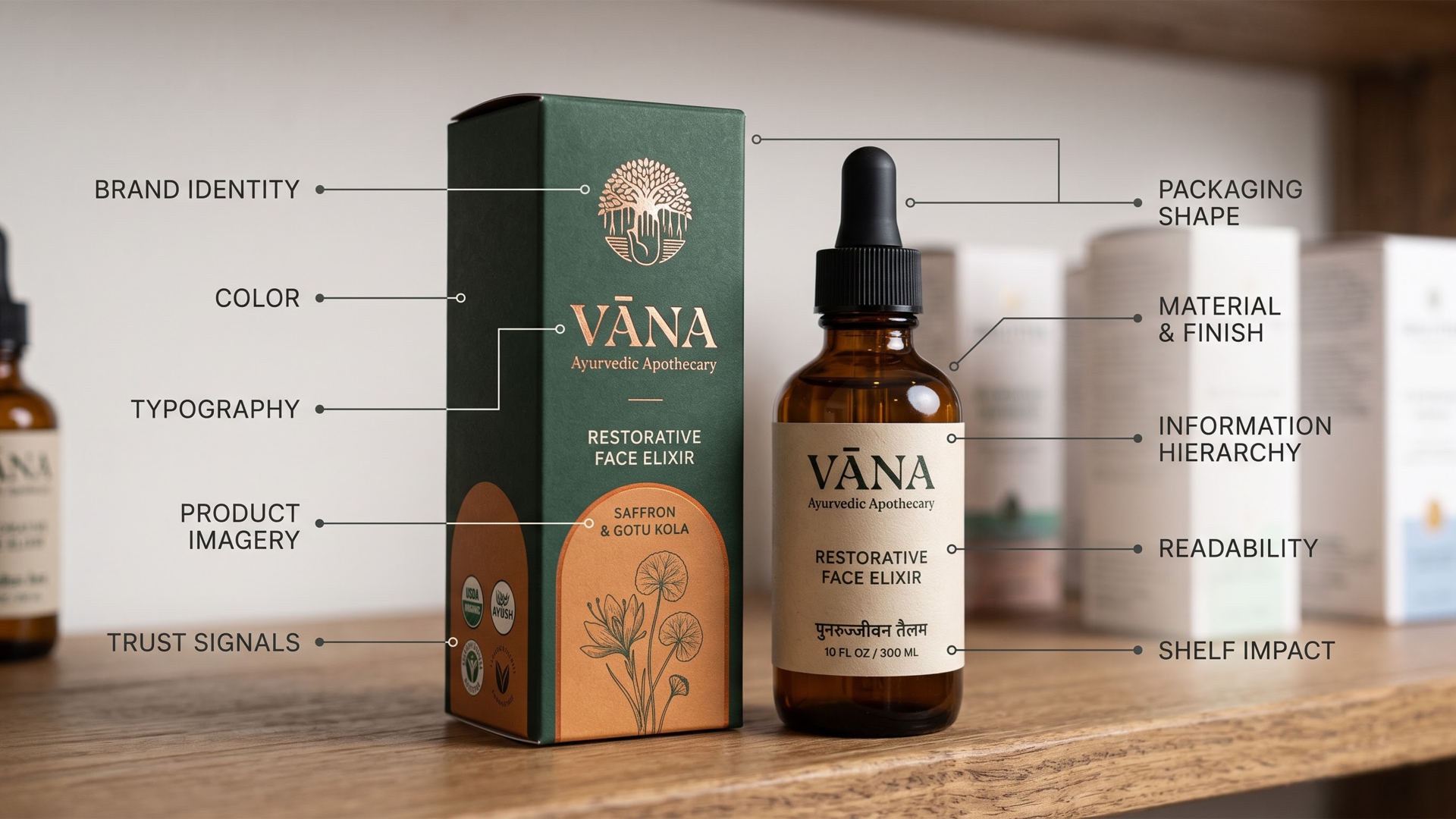
Your Product Speaks Before The Customer Sees It
Picture this: you are in your favorite store. There are hundreds of products trying to catch your attention. Some are bright, some are dull, some have unusual shapes, some have more interesting typography, some have a more sophisticated color palette.
You have not touched any products yet, read the descriptions or seen the prices.
Nevertheless, you already have a good idea of which products you are interested in.
That is the magic of packaging design!
The right packaging design communicates the key attributes of the product: quality, personality, positioning, reliability, and value. In other words, great packaging design often talks with the buyer long before the buyer actually sees the product.
Great packaging design can talk a customer into thinking that a product is healthy, organic, modern, reliable, fun, luxurious, and accessible – long before they actually see the product.
But what does it take to create a great packaging design that will influence the customer’s decision to buy your product?
Let’s look at 10 elements that make up great packaging design.
---
1. Color: What Customer Sees First
Colors are often the first characteristic of your packaging that the customer will see and respond to. Aside from the psychological impact of color on the perceived value of the product (green = healthy, blue = trust, black = premium, yellow = energetic, red = urgency), the right color combination can convey specific expectations about the product to the customer.
Furthermore, great color palettes are usually the result of understanding what the customer is likely to see and how they are likely to perceive the product based on the presentation. That is why a premium cosmetics brand rarely puts its logo on a multicolored neon sign, and a kids’ snack brand rarely uses gray and brown colors for its packaging.
A designer should think about what they want the customer to feel when they see the product presentation. Use questions such as: what would I want them to feel when they see this color combination? What would the product look like in my hand? What associations would this color evoke?
---
2. Patterns: Make Your Customer Remember The Brand
Patterns are one of the key elements that can make your packaging design memorable. In fact, a great pattern often acts as a hook that will make your customer remember the brand long after they saw the product on the shelf.
Think about the patterns as the most recognizable attribute of your brand. Sometimes, just the sight of it can trigger your visual memory and make you realize what brand it is, even if the packaging had minimal print.
Great pattern design = great value proposition.
Depending on what kind of product you are selling, your patterns might evoke different feelings. Natural product patterns will remind the buyer of nature, tech patterns will have a more graphic feel to them, and luxury patterns will be minimal and sophisticated. Great patterns will make your customer remember your brand!
---
3. Typography: What Makes Your Packaging Speak To Them
Typography can transform a generic packaging box into an unforgettable experience for the buyer.
Typography can narrate a brand story and trigger specific emotions from the buyer. It can dictate the visual hierarchy of the packaging design and much more.
A great sans serif heading will communicate power, a beautiful serif font will narrate luxury and elegance, and a minimalist sans serif body text will dictate simplicity and modernism. Typography is a powerful visual tool so the designer should invest ample time in choosing the right elements for the product and brand. As we have already mentioned, typography dictates the visual hierarchy of the packaging design.
In fact, you might want to think of it as the designer’s tool to control what the customer should see first when looking at your product packaging. You may remember from the introduction that a customer will rarely read the description of your product.
Instead, they will want to have a quick scan and get a general sense of what the product is about. This can be achieved through the basic principles of visual hierarchy that can be controlled by the designer through typography.
Great typography will essentially guide the customer through the most important information.
---
4. Structure: Stand Out From The Rest
Sometimes, in order to stand out from the rest, you need to innovate the structure of your product packaging. A unique structure can make your product more desirable, more appealing, and more differentiated from the competitors.
A unique structure often dictates the functionality of the product packaging. Unique bottle shapes attract attention, unique structures dictate eye movement, unique structure = unique product!
On a shelf full of rectangular boxes, it is the unique product structure that will get noticed first.
Great structure can interrupt the customer’s scanning of the shelf, draw attention, and create interest.
A great structure will make your product stand out from the rest while managing to still provide functionality and practicality. The structure of your product packaging should look great, but it should also serve a purpose.
Great structure makes things look extraordinary without losing practicality.
---
5. White Space: Less Is Often More
One of the hardest things that a designer will learn during their career is that, sometimes, less is, indeed, more.
White space is one of the most underrated design elements that can elevate a product packaging design to new heights. Great product design can make the customer feel as if they have purchased a unique handcrafted item when, in fact, it is a regular product.
A clean, simple design with lots of white space, one big image, simple typography, and minimal branding can be more effective than multiple icons, multiple statements about the product, multiple colors, and multiple design contrasts that clutter the design.
White space should not be avoided in your design, it should be harnessed to make the most impactful statements about your product and brand.
---
6. Visual Hierarchy: What The Customer Should See First
As mentioned earlier, a customer will rarely read a long description about a product. They will scan it and start developing an impression about the product based on what they see. A great product packaging design will utilize the principles of visual hierarchy to dictate what the customer should see first on the packaging.
An effective product packaging design will tell a visual story similar to this: brand -> product -> key benefit -> additional information -> call to action.
Knowing that will greatly help the designer in finding the right balance and prioritizing the key elements that should be seen first.
In essence, a great designer will position the elements the way the customer will see them – not the way the company wants them to see it.
The designer will control the customer’s eye movement and help them answer the five key questions about the product: What is it? What does it do? Why do I need it? What else is there to know? Is there anything else?
If the most important product information is at the bottom of the product packaging, it is the wrong design. A great design guides the eye, rather than obstructing the view.
---
7. Images/Illustrations: The Emotion Behind The Product
Images and illustrations play an important role in dictating the perceived value of the product, as well as the overall appeal of the packaging design. Product photography, product illustrations, icons, texturing, and other graphics can greatly impact the perceived value of the product and the appeal of the packaging design.
A food product might have beautiful photos of ingredients that go into the product, a skincare product might feature botanical illustrations, and even an exclusive product might have abstract art to represent itself. However, great imagery should also dictate the emotions that the customer should feel when engaging with the product.
Think about the emotions you want your buyers to experience when engaging with your product. Great imagery can make your brand tell a story.
The designer should think beyond the product and about the customer and what they should feel like when using the product. Fresh? Comfortable? Energetic? Luxury? Calm? Adventurous? Confident?
The right imagery can help the designer impact the emotional perception of the product. Great product packaging design can tell a story through graphics.
---
8. Material: What The Customer Feels Like
Various material finishes can also be utilized in product packaging design to dictate the perceived value of the product. From a simple matte finish to embossed patterns, paperweights, foil stamping, uncoated paper, raised typography, and unique material finishes that make the product stand out from the rest, the right material finish can impact the perceived value of the product.
Great products feel special, and great product packaging design can offer a tactile experience to the buyer that will complement the visual appeal of the product packaging. When a buyer touches your product, they should feel special. This will enhance their perception of the product and boost your brand image. The buyer can recognize your product based on how it feels in their hand long before they actually see it.
That is also known as sensory branding and it is about engaging the sense of touch in the buyer’s interaction with your brand.
---
9. Consistency: Building The System
Great designers know that it is important to not only design a great product packaging, but to also build the system around it. In other words, great designers think about consistency and visual language and build the foundation for other product packaging designs so that all of them follow a certain pattern.
As mentioned earlier, as soon as the customer lays eyes on your product, they should be able to understand what it is and what it is about.
That should also be true when they open the product later. A great product packaging design will allow for great consistency to be achieved across multiple packaging design projects, so that the customer can easily recognize the brand. Similar characteristics can include color palettes, typography, logo placement, pattern variations, illustration styles, iconography, photography styles, structural hierarchy, and more.
At the same time, a designer can ensure that each product is different enough to be easily recognized as a separate product by utilizing different accent colors, graphics, and structural orientations.
The customer then will be able to have a consistent product packaging design experience while also being able to distinguish between different products.
Consistency builds brand recognition, while differences allow for individual product recognition.
---
10. The Unboxing Experience: Engaging The Customer
Great product packaging design can also utilize the unboxing experience to engage the customer and, potentially, encourage them to share the experience with others on social media. In fact, the interaction that a buyer has with the product packaging can be leveraged by the brand to encourage them to post about the purchase on social media. The customers can share their unboxing experience on social media or word of mouth and, effectively, market the product for you.
Let’s imagine that you have bought an amazing product with a great packaging design. Let’s imagine the customer journey that the buyer undertakes:
Customer sees the package -> customer picks the package -> customer opens the package -> customer sees something amazing -> customer enjoys the product -> customer remembers the great experience due to the amazing product packaging design.
Everything that happens throughout this experience is Influenced by the product packaging design.
