
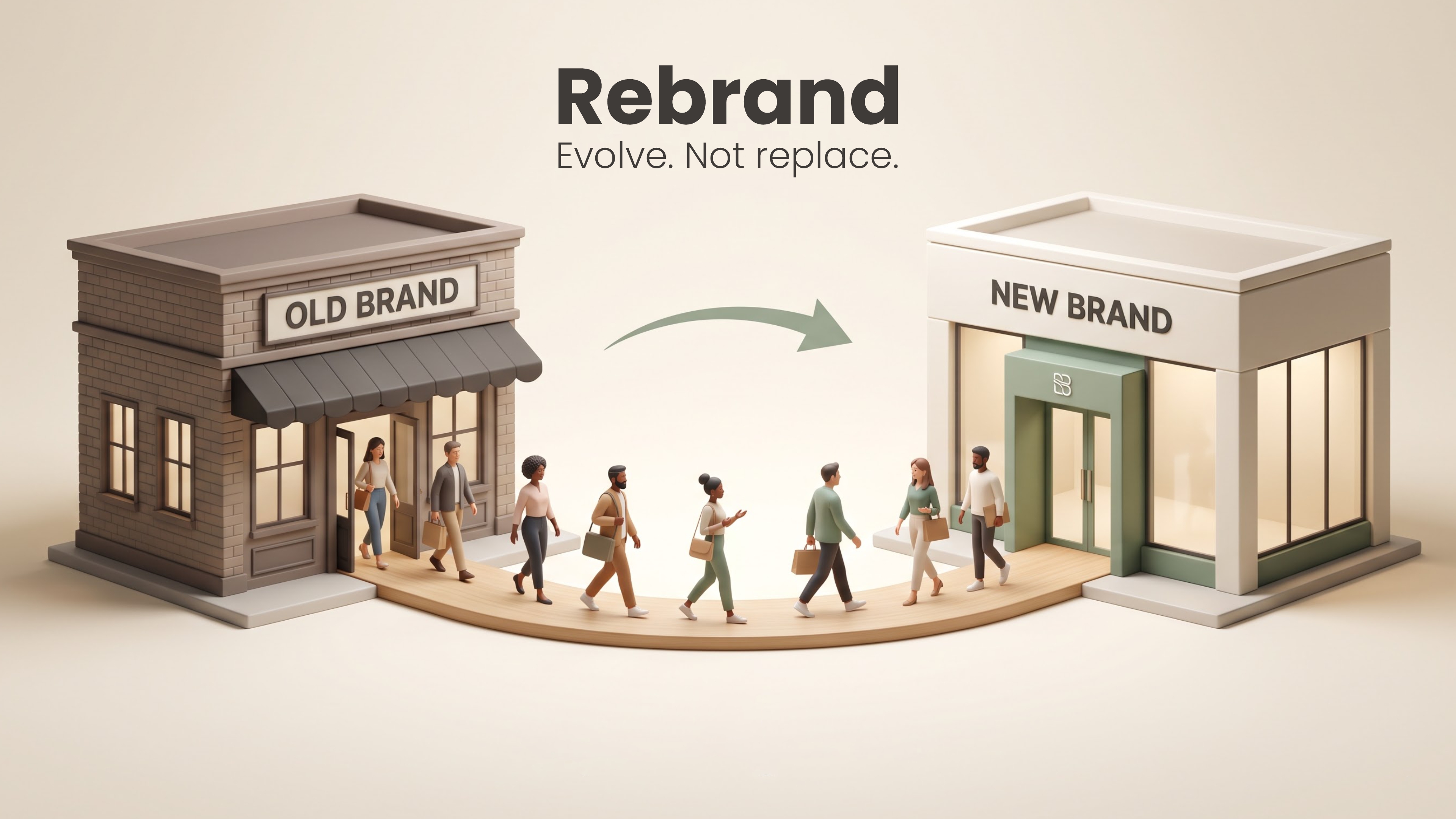
Rebranding sounds wonderful in a meeting where discussions about a new logo, new colours and a fresh-looking website is done. This makes everyone feel that the business is getting a new life.
But what about the customers who already know the business?
If a company has been around for years, people may recognise its logo, colours, packaging or the way it communicates. Yes, they do not think about these things every day, but they still remember. So when an established business changes everything, customers can feel a little confused. They may have questions like:
This is why how to rebrand a business is not a design question; it is about understanding what people already know about your brand and deciding what needs to change without throwing all of it away. A good business rebrand should feel like the business has grown and not like the old business has disappeared.
Before changing logo or choosing new colour palette, stop and ask: Why are we doing this? It may be because the company started 15 years ago and the visual identity now feels old or that the business has grown and offers more products now or maybe the original audience was very different from the audience today. Sometimes company positioning has changed too.
For example, a business may have started as a small local service provider and has now grown into a company serving customers across different cities. Here the old branding may not communicate that growth.
There could be practical reasons such as the logo may not work on digital platforms or packaging looks inconsistent or that the website, social media and printed material all look like they belong to different companies. These are all valid reasons for a business rebrand.
Businesses don’t need to start from zero.
A brand refresh is a lighter change wherein the business is still the same, but the way it looks and communicates is updated. You may keep the logo idea but simplify it or you may keep the main brand colour but use a modern shade and change the typography as well as get the packaging cleaned up.
A full rebrand involves changing brand positioning, messaging, visual identity, logo and the overall way in which the company presents itself.
Bigger change is not always better. If the basic brand is still strong and customers recognise it, a brand refresh may be enough.
This is one of the most important things. An established business has recognition, this is because customers remember the brand. It may be due to a colour, a symbol or its packaging. All these things have value so before changing everything, know what customers already associate the business with. Say, if a particular colour is used by a company for 15 years and customers strongly connect it with the brand, then completely removing it is not wise, the colour can be updated instead. The same applies to a logo so the logo does not have to disappear but maybe only simplified.
This is one of the biggest ideas of successful rebranding as you are not starting from zero but you are starting with some history.
Businesses spend months discussing what they ‘think’ customers feel about the brand but they could just ask them. So, before finalising a rebranding strategy, speak to existing customers. You can just ask simple questions such as:
These answers can be really useful. The company may assume that customers are attached to the old logo, while customers may actually remember the brand for their packaging colour or the quality of service. Or the business may think the brand feels traditional, but customers may see that tradition as trustworthy. This is why the rebranding process should include listening and then designing.
A rebrand is: what customers already know + what the business needs now.
So, you can keep the core colour but modernise it. You can keep the personality but make the communication clearer or keep the heritage but enhance the visual identity. This is important for old established businesses as their history can actually be part of the brand story. The idea is to make the business relevant for today.
People often start with logos or fonts and colours. But a proper rebranding strategy should come before all of that.
Start with the current situation:
Then think about where the brand wants to go:
Once this is clear, the visual changes are easier to decide. The logo, colours, website, packaging and messaging should support the same thought or you’d just end up with a new-looking logo and the same old confusion.
Imagine you have been buying from a company for ten years and one morning you open Instagram and see that the company has a different logo, colours, packaging and the tone and nobody has explained anything. You may eventually figure it out but for a few seconds you are confused. That is why communication is an important part of the rebranding process.
Tell customers what is changing and why. This does not have to be a huge emotional campaign but a simple message like “We have grown, our identity is growing with us.” also works. This makes customers believe that while the brand has grown, the relationship is still the same.
A rebrand needs some planning as you don't want your Instagram profile to have a new logo while the office signage still has the old one, the website has half-old colours and your sales team is sending presentations with three different versions of the brand.
It gets messy very quickly.
A proper rebranding process can be rolled out in stages.
First, employees should understand the change.
Then the website and digital platforms can be updated.
After that, marketing material, advertisements, packaging and physical spaces can be changed depending on the business.
The exact order is different for every company.
But consistency is important.
Customers should slowly start seeing the same new identity everywhere.
Your Employees Need to Understand the Change Too
Rebranding is not only for customers.
Your employees are going to represent the new brand every day.
So they should know why the company is changing and what the new identity actually means.
If the company says it is now more friendly and approachable, but the sales team is still communicating in a very formal and distant way, there is a gap.
If the new brand has a particular tone of voice, employees who write emails or social media content should understand it.
Simple brand guidelines can help with this.
They can explain the logo, colours, fonts, imagery, tone of voice and basic usage.
It doesn't have to become a giant 100-page document that nobody opens.
Even a practical guide can make a big difference.
Don't Copy Every Branding Trend You See
This is another trap.
Every few years, branding trends change.
One year everything is minimal.
Then gradients become popular.
Then everyone wants bold typography.
Then suddenly everyone has the same simple black-and-white identity.
Trends can be useful for inspiration, but your business rebrand should not be based only on what looks fashionable right now.
Ask whether the new identity actually suits your business.
Will it still make sense three or five years from now?
Will customers understand it?
Does it help you look different from competitors?
A brand should feel current, but it doesn't need to chase every design trend.
Sometimes simple and clear works much better.
How Do You Know If the Rebrand Worked?
The launch is not the end of the rebranding process.
It is actually when the next part begins.
Once the new identity is out, pay attention to what happens.
Are customers recognising the new brand?
Are they confused?
Are people asking why the company changed?
Is the website getting better engagement?
Are enquiries increasing?
Are customers responding positively to the new packaging or communication?
Of course, not every result will immediately show up in numbers.
Some changes are about perception and recognition, and those can take time.
But feedback is still important.
If customers are consistently confused about something, don't just say, “They will get used to it.”
Maybe something actually needs to be explained better.
A successful rebranding process should leave room for learning and small adjustments.
A Rebrand Should Feel Like Growth, Not Disappearance
Rebranding an established business is a little different from creating a new brand.
When you are starting from scratch, there are no existing customers wondering what happened to the old identity.
An established business has to think about them.
That doesn't mean you should never make big changes.
Sometimes a complete change is exactly what a company needs.
But it should be a thoughtful decision.
If you are thinking about how to rebrand a business, start by understanding what already has value. Find out what customers recognise, what feels outdated and what the business needs to become next.
Then build the rebranding strategy around that.
Because a good business rebrand isn't simply about having a newer logo.
It is about making the brand look and sound more like the business it has become, while still giving existing customers something familiar to hold on to.
The best kind of change doesn't make people feel like they lost the brand they knew.
It makes them feel like the brand they already knew has simply grown up a little.
