
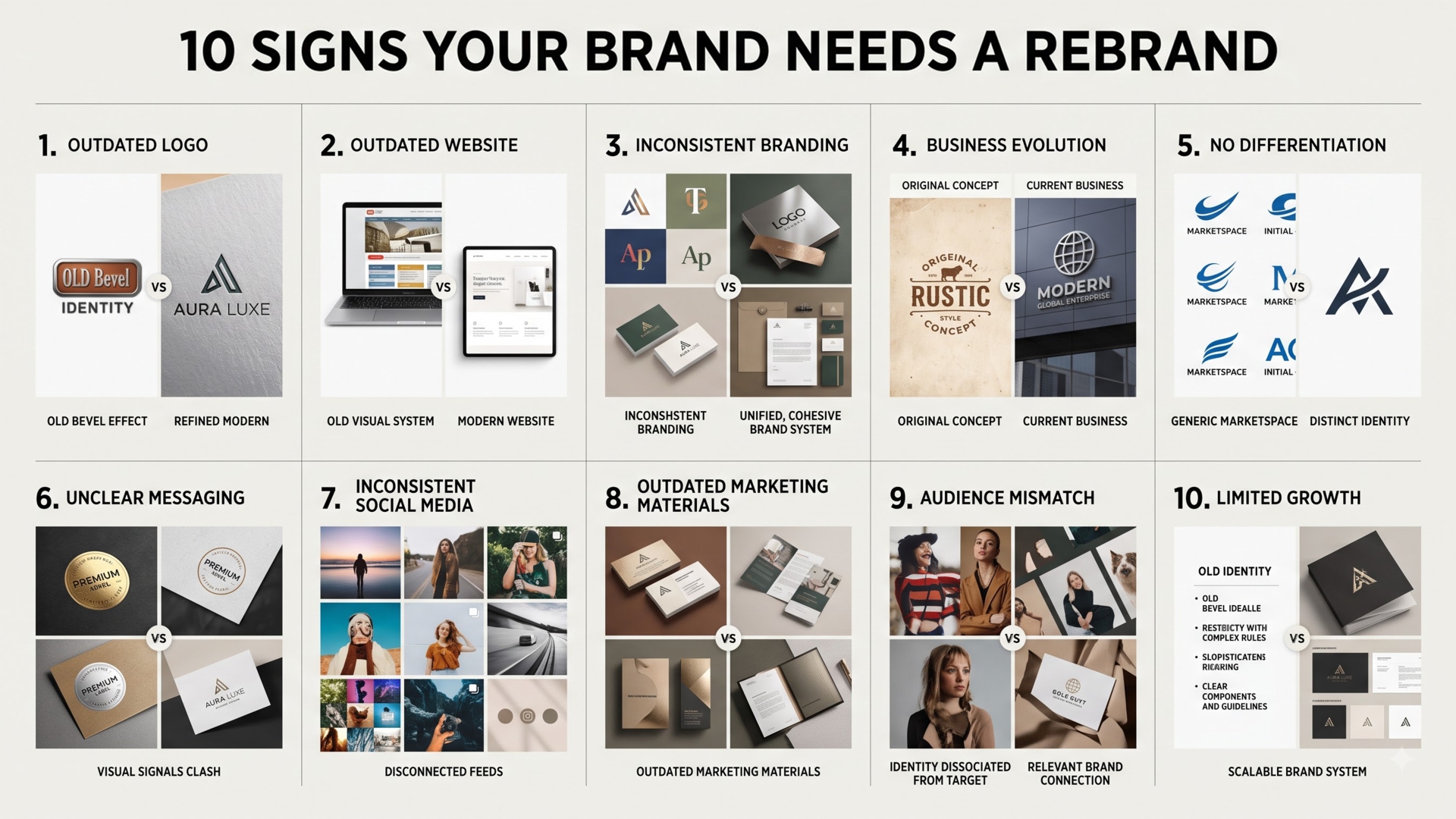
Rebranding does not simply refer to the design: a company’s positioning, brand identity, and customer experience can all be refreshed in the rebranding process.
Your company’s visual communication and design should reflect the products/services, customers, and market
1. Your Business Has Changed
If your business has changed – you offer more products/services, you have expanded significantly or gained new customers, etc. – your old branding may no longer represent the company in the best possible way
If, for instance, your company used to provide web design services and has since evolved into a digital and technology consultancy, a brand refresh would allow you to highlight your expanded services.
2. Your Target Audience Has Changed
Your ideal customer has changed: in today’s increasingly competitive markets, customers’ tastes, buying habits, and expectations may all evolve, shaping your branding and marketing strategy
According to Deloitte’s 2024 Consumer Loyalty Survey 73% of respondents said that personalized experiences or rewards were important to them, while only 60% felt that they received the personalization they expected.
3. Customers Don’t Understand What You Offer
As a brand, you have to be able to communicate who you are and what you do in a way that customers can understand. If you cannot define yourself clearly and succinctly, your positioning may not be correct. Your brand might not be able to tell customers what makes you different, or you might be trying to appeal to everybody at once.
A rebrand can help you clarify your value proposition: that is, what you do, for whom, and how you do it differently, if at all.
4. Your Visual Identity Looks Outdated
Your customers need to form the best possible first impression of your business. A dated brand identity does not necessarily mean that your company is out-of-date, but you may need to update your visuals in order to renew your image
It is important to note that you should not update your design simply because a trend is happening – try to build a brand identity that reflects your positioning rather than chasing graphical trends
5. Your Branding Is Inconsistent
Does your website use a different tone of voice, colors, or logos than your social media accounts? Is your email marketing vastly different from your website and blog? This is a strong sign that you need to reconsider your branding, or even rebrand entirely
A branding / rebrand project should involve developing brand guidelines that describe the specifics of your brand – for instance, rules for logo use, brand colors, typography, photography, tone of voice, copy / messaging, web and social design, materials and print, and other elements
Having these guidelines can help you achieve greater consistency across all of your branding materials.
6. Competitors Are More Memorable
Sometimes, being able to deliver an excellent product or service is not enough: in order to stand out from the competition, you need to be able to make yourself memorable and recognizable. If your competitors have more recognizable brands, you may need to rebrand in order to become more memorable yourself.
Remember that memorability often comes from being unique – rather than trying to appear similar to other companies, consider emphasizing what you do better or differently. Your rebrand should capitalize on your strengths.
7. Your Brand Promise Doesn’t Match Reality
One of the worst brand positioning errors is promising customers something that you cannot deliver. Updating your brand visuals may do little to improve customer satisfaction if your operations do not support your branding.
Today, customers demand much from brands – in particular, trust. As per NIQ’s 2026 Consumer Outlook , 95% of consumers say that trust matters when it comes to brands.
8. Your Company Has Lost Relevance
Markets evolve, as do customers’ expectations – and sometimes, brands that were once popular or prominent can find themselves “stuck in the past.” In such cases, a rebrand can be extremely useful in reviving a brand and helping it regain its status with the public. Note that relevance should not be confused with “chasing trends”: your brand should continue to represent the core values that customers have come to expect from you. At the same time, you may need to update your brand design and visuals to better align with the current market environment and conditions.
9. You Have Experienced a Major Business Change
Sometimes, a company’s internal operations can change to such an extent that its branding no longer supports its operations or desired image. Mergers and acquisitions, leadership transitions, product innovations at the regional or global levels, and other major events can all require a rebrand in order to reflect these changes. Such a rebrand can help you renew your image while still supporting your current operations and customer base. At the same time, you should always remember that customer perceptions are critical: per Clutch’s 2025 research (404 US consumers surveyed), 87% of respondents formed assumptions about a company when a familiar brand used new designs or communications. Of these respondents, 43% believed that the company was “just becoming modern/cooler,” while others assumed that the company was targeting a different audience or simply trying to hide certain problems.
10. Your Brand Doesn’t Differentiate You
Most importantly, ask yourself if your brand tells customers anything unique about your business. Unfortunately, many brands utilize generic terms, “buzzwords,” or industry-specific language that fails to make them stand out from the competition. Differentiation is critical in branding: your brand should say something specific about who you are, what you do, or how you operate. For example, rather than stating that your company is “innovative” or “high-quality,” consider what you can do better than anyone else and position yourself accordingly. Ask yourself the following questions: What makes us different/better? Who are our target customers? What do we do best? Why should customers choose us? What should they remember about us? Then, develop your brand positioning, messaging, design, and customer experience strategy around these answers.
You may not need a full rebrand – if your brand positioning is largely correct but your colors, graphics, and other design elements seem “outdated,” consider undertaking a brand refresh rather than a rebrand. Such a refresh usually updates your branding without changing your overall positioning, messaging, or identity. However, if your business strategy, target customers, and/or market positioning have changed, you may need to consider a rebrand. Either way, it is critical to conduct proper research in order to understand what your customers want and need from you before embarking on your brand development project.
There is no hard-and-fast answer, but you should consider rebranding when your positioning or target audience changes, or simply to refresh an “old” brand.
It can, but you must understand what your customers want and need in order to accomplish this goal. As mentioned above, 95% of consumers state that trust matters when it comes to brands.
When should a business rebrand? Your brand should change when it no longer reflects the qualities that you want to be known for. Most often, rebranding is not about being different but about being clear, relevant, unique, and trustworthy. Your brand should evolve with your company, but never stray too far from the characteristics that have earned you customers’ trust in the first place.
