
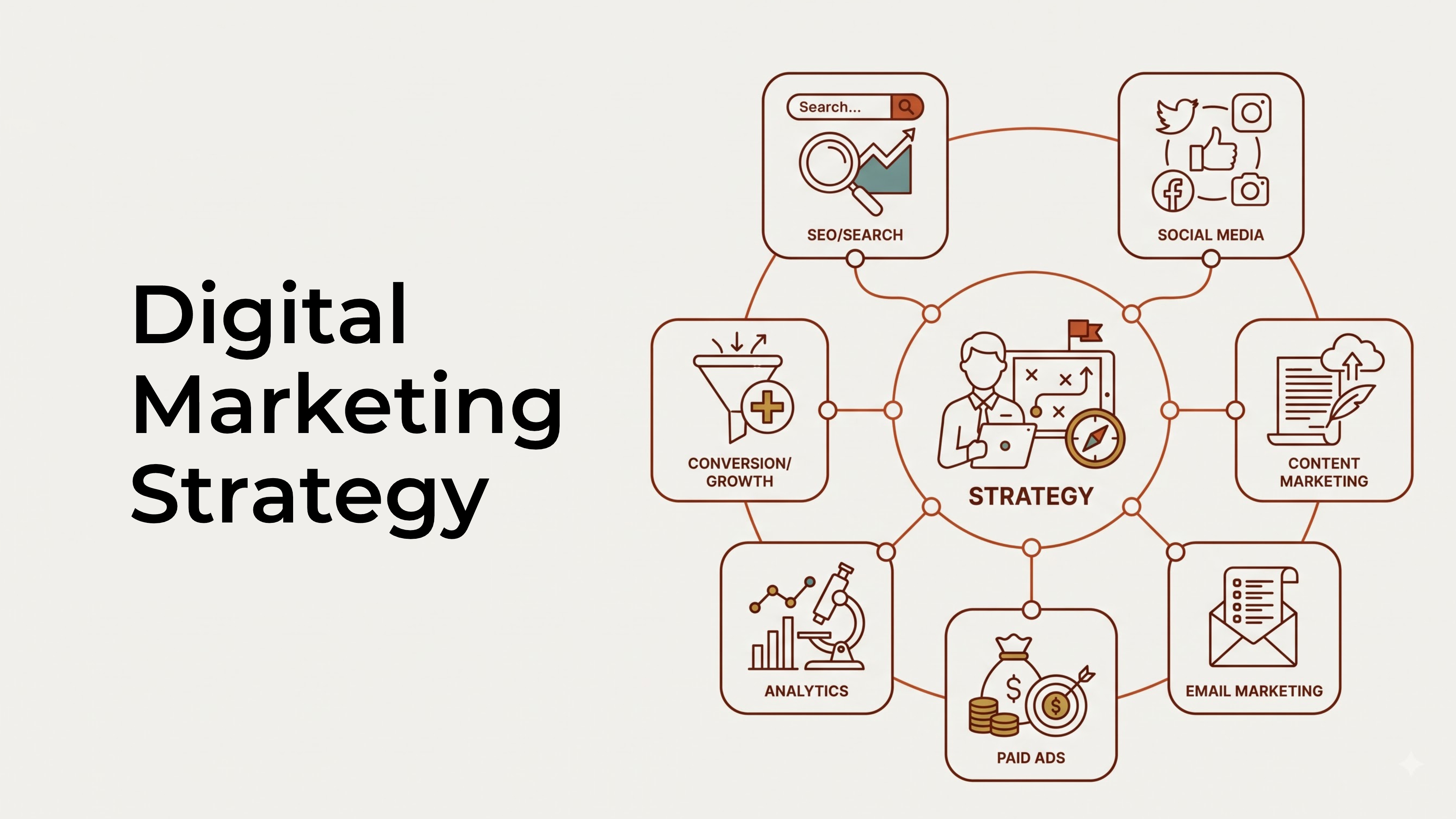
Take any business and you would see that they have been advised by multiple sources to post on social media, start a blog, run ads, send emails and even work with influencers. They would also have been given mixed opinions regarding development of their business ranging from building it qualitatively and then trusting the word-of-mouth or focusing on online marketing channels by engaging with Google, Instagram, LinkedIn, and paid advertising. Just because they have been instructed to do everything at once, it stretches a small team, makes the budget run too thin and leaves the business with half-finished activities rather than one completely developed marketing channel that works for them.
As such, there's no single channel that works best for every business and that also includes the right choice a business makes while deciding for the best digital marketing channels, as it all depends on the audience, business goal, budget and the time availability of the business.
Before thinking on how to choose digital marketing channels and which channels to choose, decide what the business actually needs. Think carefully and answer if the goal is to get more enquiries and generate leads, sell products online, build brand awareness, bring back existing customers by customer retention strategy or enter the new market.
Another aspect is knowing the difference between vanity metrics and business results. For instance, a B2B consultancy may value 5 relevant enquiries more than 5000 views from people who will never need its services, thus knowing this difference itself can help the business a lot. Followers’ impressions may be a useful indicator of how your business is soaring and through how many eyes it goes through on the online platforms, but they are not the same as revenue or qualified inquiries and can never be the business results. Thus, knowing how to choose digital marketing channels is based on the goal and the purpose of the business. But before that, understanding all the marketing channels itself can clear out the clouds of doubt.
SEO can help a website appear in organic search results wherever relevant, especially when the people look up for some product, service or answer.
When customers actively search for what you sell, when your website can answer specific questions, if your business can invest in content and technical improvements over time or if the customers research before making a decision, that is when SEO helps you to get the attention of your customers. There are various benefits of SEO, one of the major one being able to attract relevant visitors without paying for every click which eventually supports the discovery and building visibility over time.
SEO, however, is not instant. Factors such as competition, website quality, content usefulness, and even search demand can affect the result of SEO due to which rankings cannot be guaranteed. In order to use SEO as a key strategy to build the best digital marketing channel, businesses may refer to Google’s guidance that recommends useful people-first content strategies that can elevate their growth.
Social media helps the brand become more familiar, show around their work, engage with customers and even directs interested people towards their website. Instagram, for example, can display the visual products, design, lifestyle and behind-the-scenes content that makes the customer more connected with the brand. LinkedIn is for professional audiences wherein you can have business conversations and share B2B expertise. Demonstrations, tutorials and longer videos can be posted on YouTube, which can help the customers to make informed decisions. These online marketing channels are just possible fits, not rigid rules.
Social media requires more than just uploading a graphic generated by AI. Social media marketing involves planning, writing, responding, producing creative work, and reviewing results. For instance, Zomato is a good example of how a brand can use social media marketing to communicate via using humour, everyday situations related to food, and conversations around things people can easily relate to. They don’t make every post feel like an advertisement asking people to order food, but the communication feels less like a familiar voice. Social media marketing works only when a business knows why it is using a particular platform and what it wants people to feel and do.
Content marketing answers questions people have before they decide to spend their money on your business. Think about buying furniture, it requires people to consider the size of their room, storage requirements, design preferences and how much they can spend. IKEA's room inspiration, product information and planning resources content can help customers imagine how products could fit into their own homes. This is content marketing where the content is useful even before the customer makes a purchase.
Basically, content needs to match the questions customers actually ask. A small guide for building your content is to see which things people repeatedly contact your team to understand. It can be anything ranging from pricing, product differences or installation requirements and these could become useful website content.
Content marketing helps people make better informed decisions and this also works hand in hand with SEO, as content helps search engines understand what a website offers and which questions its pages answer.
A person visiting your website may not be ready to buy as they may be comparing prices, or waiting for their salary, or maybe they are exploring options. Email marketing is a way to stay connected with people who have chosen to receive their communication.
Spotify is an example of how personalised communication keeps users connected. Spotify Wrapped is not just an email marketing campaign, it addresses a big marketing idea: information that feels personal to the user can encourage engagement and bring people back to a brand.
However, sending the same promotional email every few days will not create a meaningful relationship. This communication needs to be relevant, useful and should not be spamming customers' emails.
PPC Advertising known as pay-per-click advertising takes place when businesses pay for placements on platforms such as Google Ads. This helps a business reach people especially when it needs visibility faster than organic SEO efforts may provide. Amazon, for example, helps shoppers discover products while they search for it, is a classic example of PPC advertising.
The customer would still check product listing, price, reviews, delivery information and competition which influences what a shopper actually buys. This is why PPC advertising should be measured beyond clicks and impressions. Analysing through mediums such as cost per lead, cost per sale, conversion rate and return on ad spend can help a business understand whether the money is producing results or not.
Influencer marketing is when a business introduces its products or services through creators who have a built audience base.
Take a real life example of how beauty brands work with creators on platforms such as Instagram and YouTube. A creator might demonstrate how a product is applied, explain its texture or share their experience using it, this gives customers a more practical view of the product. However, a creator's audience, credibility and the relevance of the content matters in Influencer Marketing much more over the number of followers alone.
Affiliate marketing is when businesses provide a commission to an affiliate who could be an influencer endorsing your product when they help you generate sales or lead through a tracked link. For a business that thinks of considering this channel, the first question should be if the product has enough margin to support commissions while remaining profitable or not. Second should be if there are relevant creators or affiliates whose content can influence the decision of buyers or not.
Affiliate marketing can be useful when the product is easy to recommend, where the sales can be tracked and the commission structure works for everyone involved; as just generating more sales may not mean earning more profit in this case.
While all these tools definitely do make sense individually, however, the next question that arises is how to choose digital marketing channels that work for your business. These answers become easier when we stop treating each and every channel as something that each and every business must have.
Take Airbnb, for example. The business depends on people discovering places to stay, then comparing options and booking accommodation if they feel confident. So their main target should be the search visibility, attractive property listing and customer reviews that can make their business soar. Another such example could be of a local saloon which can work well with the help of Google business profile, local SEO, customer reviews and Instagram profile that shows us work. But on the other hand, if there is a company that sells industrial machinery, they may need a detailed website, content, search, advertising, LinkedIn communication and much more to reach their business buyers.
Thus, before thinking of even half to choose digital marketing channels, consider three things.
It is always wise to start with only two or three suitable channels that are more manageable than spreading the same budget across six to seven platforms and channels that may not work well enough. Once a business understands what works for them and it gradually expands then they may also expand their channels.
Businesses need to take a pause here and look beyond the numbers. A simple rise inIs really impressive, but does it automatically mean that the business is growing? The number of clicks you may get from option 1 may be more but if only 5 out of those 1000 clicks become customers, then you need to compare the same with option 2 where you may have invested more but still get around 20 customers.
A blog, for example, should not be judged by how many people read it, but it should be judged by how it attracts relevant visitors and supposed enquiries. Businesses should also consider the cost of acquiring a customer and the profit generated from that customer.It is also worth remembering that customers interact with several channels before buying. Someone could discover your brand through Instagram, then read a blog, search for reviews later and then finally purchase after they receive an e-mail from your end. So just giving all the credit to the last interaction can hide the contribution that the other channels have made. Thus, evaluating half each channel contributes to their profit making will help you to determine which is the best digital marketing channel for your business.
Thus, the best digital marketing channels do not necessarily have to be the popular ones, but they are the ones that help a business to reach the right people, meet the goals and use its resources sensibly. SEO, social media, content marketing, e-mail, PPC, influencer partnerships, and affiliate marketing all have their equal importance, but their value depends on the business that uses them.
Start by understanding your customer, choosing a mix and tracking the outcomes that you get. Build on what works, improve what does not, and thus change your decision based on the information and analysis rather than following the trend. In this way, you'd be able to spend your marketing budget and build a strategy that can grow your business wisely.
