
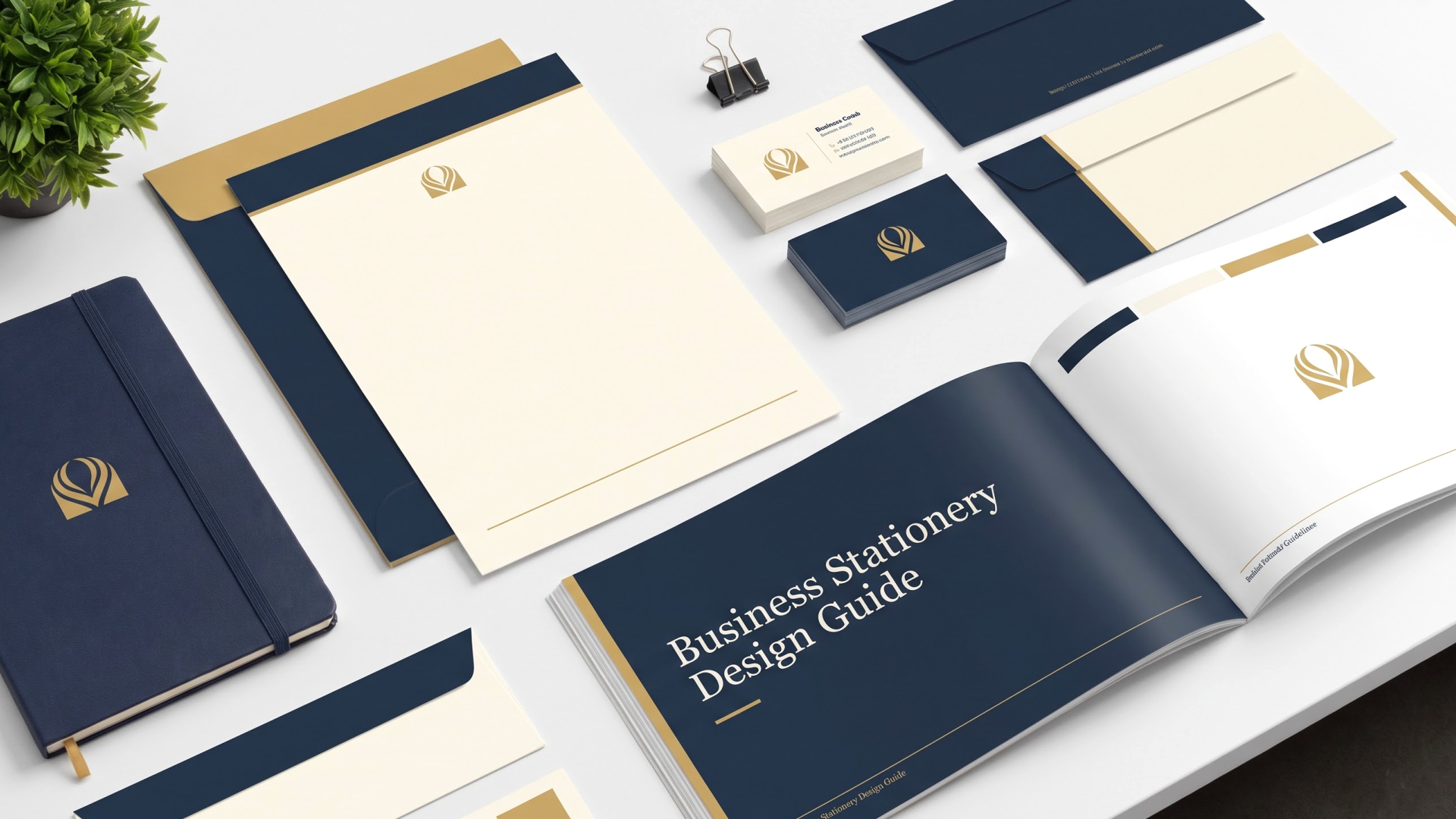
Every touchpoint a customer has with your company shapes how they perceive your business, and that includes the paperwork. Business stationary design, the visual system behind your business cards, letterheads, envelopes, and other printed materials is one of the most underrated tools in brand building. Companies that invest in professional stationary design services create a cohesive identity across every document their clients see, from a business card design handed out at a networking event to the letterhead design used on a signed contract. Add in thoughtful envelope design and consistent corporate templates, and a business signals credibility before a signal's credibility before a signal word is read. This guide breaks down why stationery design matters, what criteria go into doing it well, and which stationery elements every growing business should have in its brand kit.
Why Does Business Stationery Need to Be Professionally Designed?
Stationary is often treated as an afterthought, something ordered quickly online once a logo exists. In practice, it functions as a silent extension of your marketing strategy. Every invoice, envelope, and notepad a client touches either reinforces trust in your business or quietly chips away at it.
A few reasons professional design matters more than the most businesses assume:
In short, stationery isn’t paperwork, it's a recognition system. Every element you print is either building brand equity or quietly undermining it.
In a world where most communication has moved online, it’s tempting to assume printed stationery doesn't matter anymore. The opposite is often true. Because physical, branded materials are now less common, they stand out more when done well.
When a client receives a professionally branded quotation, contract, or business card, they form an instant impression of legitimacy. A generic Word document or a mismatched envelope, by contrast, can make even a well-run business appear disorganized or less established than its competitors.
Every piece of stationery logo, color, palette, typography, tone of voice is a small repeated exposure to your brand. Marketing research shows that audiences typically need several consistent exposure to a brand before it becomes truly memorable, which is exactly why uniform stationery across every touchpoint matters so much.
A business card exchanged at a conference, a branded folder handed to a client, or a personalised notepad left on a desk will carry your identity into spaces your website and social media can’t reach. This is particularly valuable for real estate agencies, law firms, medical practices, and consultancies, where formal, paper-based communication still plays a large role in client trust.
A business that takes care to align its stationery with its brand guidelines signals that same care extends to its products, services, and clients relationship. Conversely , sloppy or inconsistent printed materials suggest the same disorganization might apply elsewhere.
Not all stationery design is created equal. Whether you are designing in-house or outsourcing to professional stationery design services, a few criteria separate polished, effective materials from generic templates.
Every piece from business cards to invoices should use the same logo treatment, color codes, fonts, and spacing rules. Inconsistent shades of a "brand color” or multiple slightly different logo versions dilute recognition rather than build it. A documented brand style guide should govern every stationery item produced .
Font choice affects readability and tone just as much as color does. A law firm stationery calls for different typographic weight and formality than a creative agency’s. Color psychology also plays a role: the palette chosen should align with the emotional tone the brands want to project, and should remain identical across print and digital formats.
Effective stationery design resists the urge to fill every inch of space. Clean layouts with generous whitespace look more premium and are easier to read, whether it' s a letterhead, an invoice, or a folder. Essential information company name, contact details, logo should be easy to locate at a glance.
Design doesn't stop at the screen. The weight and texture of the paper stock, the finish (matte, glossy, textured), and printing method (offset, digital, letterpress, foil stamping) all influence how premium a piece of stationery feels in someone’s hands. A well-designed letterhead printed on flimsy paper undermines the intended impression.
Good stationery design also has to work in the real world. envelopes need to fit standard mailing formats, business cards need to hold up to repeat handling, and invoices need clearly organized fields for financial details. Design and usability should never be treated as separate concerns.
A strong stationery system should scale cleanly from a small business card to a large presentation folder, and from print to digital PDF versions of the same documents, without losing legibility or brand integrity.
A full stationery suite typically includes far more than just a business card and a letterhead. Below is a breakdown of the core elements every business should consider as part of its corporate stationery system.
Still one of the most exchanged marketing materials in professional settings, a well-executed business card design communicates brand identity in a few square inches. Key details — name, title, contact information, logo should be legible, with a layout, paper stock, and finish that matches the tone of the business.
Every formal letter, proposal and contract sent by a company is governed by the letterhead design. It should be obvious what the company is, and not too cluttered with information, but usually contain the logo, company name and important contact details. To be consistent, envelope design should align with the letterhead's branding, making a piece of mail recognizable even before it is opened.
For client meetings, proposals and press kits, presentation folders are a branded container for a company's most critical pieces of information. A nicely designed folder, with pockets and a clean cover treatment and room for inserts (business cards, brochures) increases the perceived professionalism of all the contents.
Financial documents are a type of stationery that is seen more often by a client than any other, but is rarely done the most beautifully. When a business presents an invoice or quote that is branded and well organized, the fonts, logo placement and the organization of line items can build trust in that company's financial professionalism.
Custom stamps with a company's logo, name, or approval marks (like “Paid,” “Confidential,” or “Approved”) enhance the authenticity of physical documents and remain popular in certain fields, such as law, real estate, logistics, and government-related services.
Inside and on client desks, branded notepads maintain a company's identity in all interactions, whether in a meeting or for note-taking. They're an inexpensive, eco-friendly product that works by promoting brand awareness without being too intrusive
Businesses that have employees in the field retail, hospitality, events, healthcare get a sense of trust and accountability, while reinforcing the visual identity in face-to-face environments, from staff wearing branded badges and name tags.
A complete stationery system includes brochures, flyers, table talkers and other printed collateral pieces that are used at events, in store or when pitching to clients. The design of these materials should mirror the rest of the brand's stationery suite so that promotional items are never out of touch with the brand
As it is used in countless areas of business including legal, sales, finance, marketing and daily operations, it is wise to think of it in terms of a project, rather than a succession of print orders. When considering stationery design services, you should find a provider or designer who can:
Business stationery is more than just business paper; it's a frequent and palpable reflection of your brand. Whether it's a business card that starts a new relationship, or an invoice that ends a sale, any print impression affects the professional image a company has built. One of the best ways for a business to look and feel like a legitimate business is to invest in their business stationery design, which includes business cards, letterheads, envelopes, business folders, invoices, stamps, notepads, badges and promotional stationery.
