
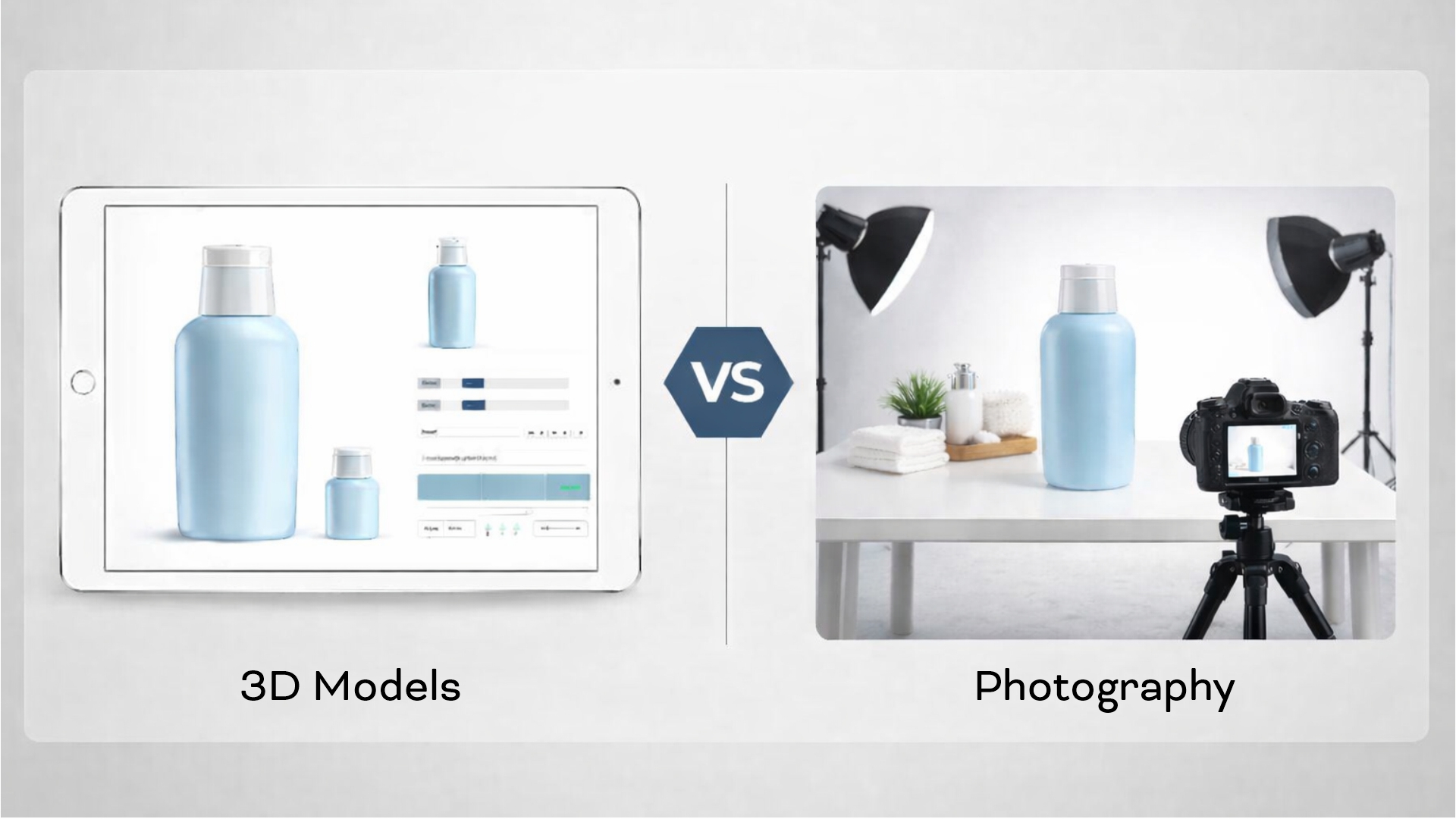
If you rewind just a few years back, traditional photography was the default choice for almost every catalogue, brochure, website, and product launch. You’d have to book a studio, arrange your lighting, schedule the photographer, move the props around, wait for edits, and finally get the pictures back. Today, as we all know the world of 3D has, happening so, taken over this process. More and more brands are quietly switching from product photography to 3D modeling and in many industries it’s becoming the first choice instead of the backup plan.
This shift naturally didn’t happen overnight. It’s the result of changing expectations, faster digital adoption, and the simple fact that 3D models solve problems traditional photography struggles at. And honestly even we, Asense Branding, a branding agency based in Rajkot, Gujarat, agree that once you see how flexible and cost-effective 3D visuals can be, it’s hard to go back.
Let’s walk through why people ranging from marketers and architects to manufacturers and interior designers are choosing 3D models over photography.
In photography, reality sets the limits. You can only shoot on what exists in front of the camera, under the lights you’ve set, and within the physical space you’ve arranged. If you want to change the angle or background later, you may need to reshoot. That means time, budget, and a lot of coordination, that too all over again.
With 3D modeling, the rules change completely.
You’re working inside a virtual environment, which means:
It’s like having an unlimited photography studio that never needs setup and never gets tired. Designers can experiment freely, marketers can request variations, and no one has to tear down sets or re-book sessions just to tweak a minor detail.
Sometimes the brief evolves halfway through a campaign which happens quite often actually however the same thing is a nightmare with photography. With 3D, it’s simply another render.
One of the biggest reasons brands are switching to 3D modeling is speed to market.
In traditional photography, you must wait for the finished product to arrive from manufacturing before you can shoot it. If there are delays, your marketing is delayed too. But with 3D models, visuals can be created long before the first real-world version exists. All you need are design files or technical drawings.
This allows brands to:
It’s especially useful for industries like furniture, real estate, automotive, industrial machinery, and electronics, and basically anywhere else where prototypes cost a lot or don’t physically exist yet.
At first glance, 3D modeling may look expensive, especially compared to one basic photoshoot. But if you zoom out, the economics often flip.
Consider photography costs such as:
Now imagine needing images for 50 product colors or multiple environments. Now, that makes the costs escalate quickly. 3D modeling, on the other hand, requires only an initial investment to build the model. After that, changes are cheap. Be it a new background, a new angle, or a seasonal theme; there’s absolutely no shipping, no studio time, no physical handling. And at the end you’re left with a reusable digital asset instead of a one-time photo.
Anyone who has managed large catalogues knows how hard it is to keep photos consistent. The lighting varies, camera lenses behave differently and even minor setup changes affect shadows and highlights.
3D models, however, live in a controlled environment. Once the scene is created, consistency becomes automatic. This is why ecommerce brands love 3D, as product grids finally look clean, uniform, and professional. That polished and steady look builds trust. Customers feel like they’re seeing reliable, accurate information rather than uneven imagery.
Modern 3D rendering engines are so advanced that even trained eyes struggle to distinguish between a render and a photograph. Materials like glass, chrome, fabric, and even skin textures can be recreated with ridiculously high accuracy. Plus, photography has technical limits. With the hard to move large machinery, reflective surfaces making it hard to shoot and tiny details becoming difficult to capture; 3D seems like the better option.
With 3D, you can zoom into the smallest screw thread or show cut-section views inside a machine; something photography can’t do unless you break the product apart.
Want your product floating in space?
Placed inside a luxury penthouse?
Displayed on a beach at sunrise?
Shown in a minimal white studio?
With photography, each environment means a different shoot or expensive set design.
With 3D modeling, environments are invented digitally. Nothing needs to exist in real life. This is particularly powerful for:
Clients can actually “see” the result before it’s even built.
This is where 3D completely steps beyond photography.
3D models can be turned into:
Users can rotate, zoom, personalize, and experience products in real time. That kind of engagement is not just visually appealing; it’s persuasive in all the right ways. People feel involved in the buying process instead of simply looking at a static image. Modern shoppers expect that level of interaction, especially online.
No travel.
No packaging.
No shipping samples.
No physical props to dispose of later.
3D modeling leaves a much lighter environmental footprint. For brands with sustainability commitments, this matters more than ever and it’s a point they can communicate proudly to customers.
If something goes wrong during a photoshoot maybe a scratch on the product or a reflection on glass, editing can only fix so much. In the worst cases, the product needs to be re-shot. With 3D, mistakes are editable. You simply adjust the model or materials and render again. No rescheduling. No hassle. Less stress. And honestly, that peace of mind is priceless.
So… Is Photography Dead?
Not at all. Photography still has a special emotional quality in many contexts. Real-world imperfections can feel human and relatable. But the balance has shifted.
3D modeling offers flexibility, speed, control, and scalability that traditional photography struggles to match which is why more people are moving toward it, especially in product-driven industries.
If you’re still relying only on photography and feeling like it slows down launches or limits creativity, it might be worth exploring 3D modeling for your next project. Start small, experiment a little, and see how it fits into your workflow; many teams realise very quickly that it opens up options they didn’t even know they had.
If you ever want to explore how 3D modeling could work for your business whether for products, architecture, or marketing visuals, feel free to reach out. No pressure, just a conversation to see what’s possible.
