
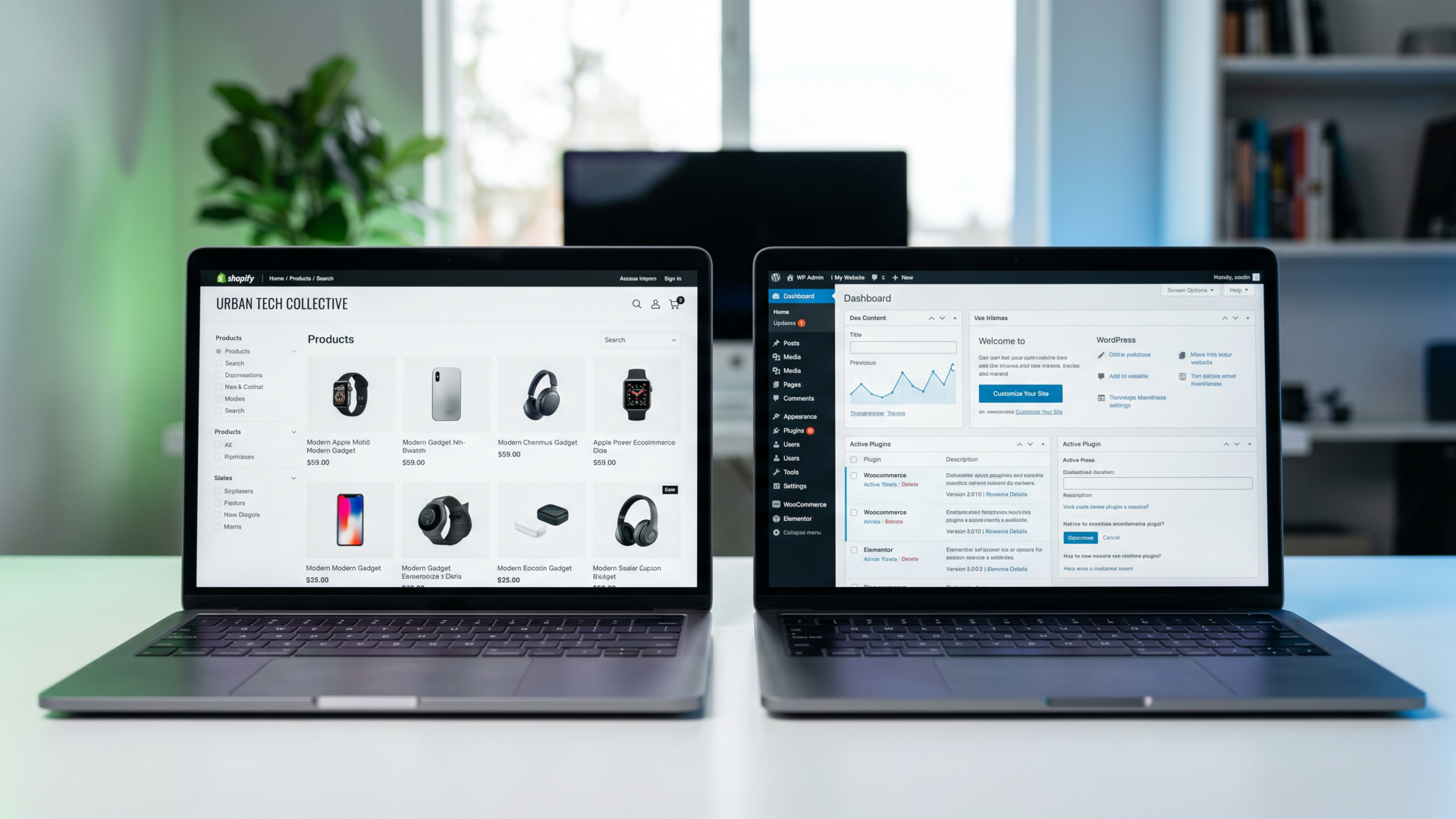
Shopify and WordPress are two of the best options to use for your business website.
Truthful, no frills breakdown that really gets you on the right track - from people who have been there.
Each week, thousands of business owners ask themselves, Shopify vs WordPress – which platform is the best platform for me to build my online store on? Every week, they receive the same answers that they have to copy and paste and which don't seem to apply to them.
Let's do it another way then. Let's discuss what really matters in business - what keeps you up at night. The kind that matters when your web site crashes on Friday night, your hosting plan doubles the monthly rate or a customer can't figure out how to checkout on your mobile.
This is the truthful division.
It's important to understand that Shopify and WordPres s are attempting to solve different problems before you choose a platform. Different people built them for different uses and different people say they are 'better' - then you find yourself rebuilding your website 18 months later.
Priya R. is a businesswoman who owns a candle company. It took her 6 months to get WooCommerce to function the way she wanted. Her developer continued to go on vacation. Her checkout was not working on the iPhones. Her first sale happened within 48 hours since she moved to Shopify. She only wanted something that would work.
Marcus K. is a digital marketing consultant and expert. He first used Shopify and it worked well for him to sell them, but his business is based on SEO and content. The blog was an afterthought. He switched to WordPress, created landing pages to his liking, and that wasn't just good; it was amazing! It brought in more income.
Priya and Marcus are correct. The honest answer to which you haven't been told.
Shopify has a thing for simplicity. Full stop. You register, select a theme from the Shopify theme market, load products and configure Shopify Payments and you're up and running. There's no plugin configuration, no database management, no hosting to worry about. The platform deals with all this on the back of its shoulders.
The other way is WordPress which is extremely powerful, but has a cost. You will have to manage your own hosting provider, install WooCommerce, set up SSL, deal with plugin updates, and backup. For those who haven't done this before, the learning curve of WordPress is steep.
Shopify is akin to signing up for a furnished apartment. WordPress is purchasing land to "build from the ground up". One is faster. One is yours forever (either yours for now or for a while).
Shopify's e-commerce capabilities are unmatched if you have a product-based company. All abandoned cart recovery, inventory management, multi-currency support, built-in discount codes, shipping integrations and point-of-sale capabilities working, and all included.
Most of these features can be matched over the use of plugins in WooCommerce. Not only do plugins take money, but they require maintenance and sometimes they interfere with one another in ways that can indeed be stressful to figure out. A high-end WooCommerce site can end up costing as much as a Shopify plan - but with none of the peace of mind.
Sophie L. is a Shopify user for 3 years and a sustainable clothing label. She ordered 600 items in 4 hours last Black Friday. Shopify didn't flinch. She had no need to consider servers and capacity. She was doing nothing more than marketing. That was all her wish.
When it comes to SEO and content, WordPress responds in a fierce manner.
Here's where the dialogue changes. If your business strategy is predicated on organic traffic - you're in Google's rank; you're getting tutorials published; you're publishing case studies; you're publishing long-form content - WordPress really is a better content management system. This is what it was designed for. By using Yoast SEO or Rank Math, you will have granular control over all the relevant meta tags, schema markup, canonical URLs, and XML sitemaps for SEO.
Shopify's blogging features are tacked on. It is not easily possible to get control over your URL structure, internal linking is a bit clumsy and creating any kind of complex content hub is a work around. This is a major constraint for a brand that is looking to establish its content marketing with a particular segment.
You can write content in WordPress, but that's not all. It allows you to establish your credibility. It's a whole other ballgame.
Cost - the truthful figures
The actual Shopify price does not only come down to the monthly cost of Shopify. Without Shopify Payments, you are charged a transaction fee on each sale, which varies from 0.5% to 2% depending on your plan. Once you start to add the applications that fill the gaps and cover features you'll find your monthly cost quickly increases.
WordPress hosting pricing begins at just a couple of pounds per month, but in case you really need to have a properly managed, secure, fast WordPress site, you will be in a host like Kinsta or WP Engine and paying a lot more. Premium plugins like forms, SEO, subscription and performance aren't that expensive, either.
There is really only one difference – it is ownership. Shopify is a rental site. You feel Shopify's pricing and/or terms change immediately. Under WordPress, you are the owner of all your data, code, and hosting relationships. This is indeed a long-term investment.
The security, hosting and reliability of the site.Security, hosting and reliability of the site.
Shopify hosts everything. Your SSL certificate, your CDN, your server capacity when you get a massive spike in traffic - Shopify has it and it works really well. It's a significant practical benefit for any small business owner that doesn't want to consider uptime.
WordPress leaves it up to you to be secure. An un-updated plugin, theme and WordPress core is a big security problem. This is all taken off your back for a fee in managed WordPress hosting, but that doesn't mean much. This is a compromise that is acceptable and is something that you should be honest about before you select.
So, what platform is one to pick?
If you're offering physical or digital goods and are looking to get your product on the market quickly, then Shopify is the correct choice. Shopify was designed for any fashion brand, product start-up, gifting company, or retailer with an online presence. At this point, reliability is more important than flexibility.
If your business relies on content, SEO or long-form stories, go with WordPress. Whether you're a marketing agency, a coach, a course creator, a blogger who sells digital products, or a service business looking to dominate Google - WordPress provides you with the depth to do it right.
One more thing I'm going to say straight out of the gate is the best platform is the one you'll use on a consistent basis. An unfinished Shopify website is better than a complete WordPress plan that remains unused. Both websites have been profitable to folks who decided to sign up and went every day.
We've taken both at Asense Branding. We've witnessed businesses grow with ease on Shopify's simplicity, and expand with WordPress' depth. This is what we all say to our clients: Your platform should be based on your strategy, not the other way around.
Can't choose which one works for your business? Let's work it out as a community. Please check out asensebranding.com and get in touch with us.
