
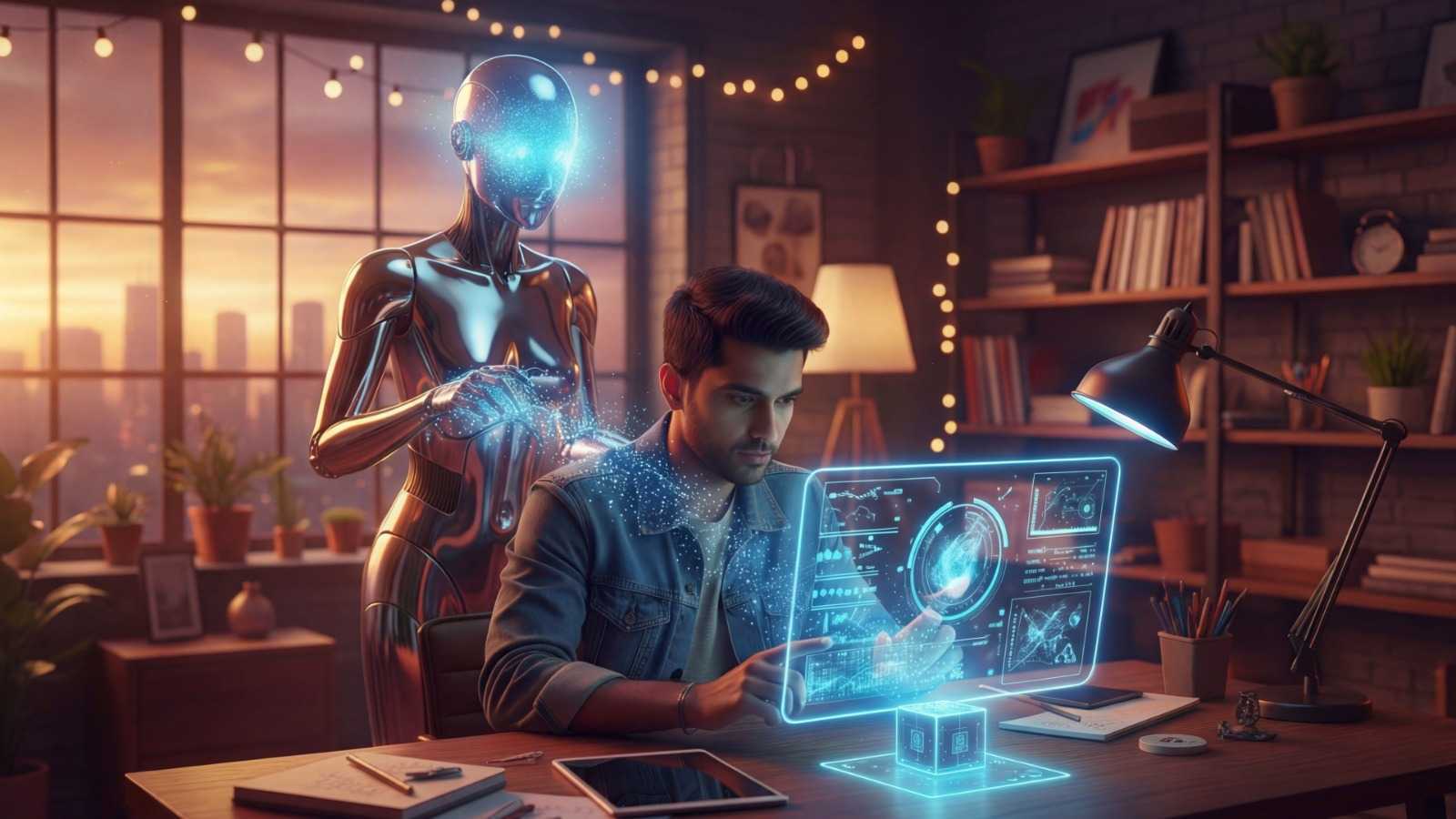
AI has quietly walked into almost every part of our lives now. They are into our phones, our workplaces and our creative spaces where we once sat staring at blank screens or sketchbooks, waiting for an idea to finally show up. Now, instead of waiting, you can type a prompt and watch a stream of text, designs, captions, code, or concepts appear almost instantly. It feels magical sometimes, definitely convenient yet slightly scary too. And somewhere in the middle of all of that, a very real question keeps showing up in the back of the mind.
If a tool can write, design, compose, suggest and analyse better and faster than I can some days, does that mean my creative voice slowly fades into the background? Does AI make us sharper creators or does it quietly
These are not technical questions. They are emotional ones. And they matter. Because creativity is not just about producing content or ideas. It is about identity, expression and perspective. The way you see the world and how that reflection finds its way into words, visuals, music, strategy, or whatever your craft happens to be. So the goal is not to reject AI or fear it. The real goal is learning how to use AI without losing the spark that makes your creativity yours.
It helps to begin from a simple truth. AI is incredibly smart at patterns. It reads, learns, blends, recombines, and predicts. But creativity is not only about combining patterns, it also comes from memory, smell, sound, chaos, emotions, mistakes, confusion, boredom, and also long walks and late-night thoughts and even bad ideas that eventually turn into good ones. AI does not feel excited when an idea works. It does not stay awake thinking about a line or a colour palette. It does not hesitate, doubt, laugh, cry, or get inspired by sunsets or music or human connection. You do.
So the healthiest way to think about AI is this. Treat it like a super fast assistant. A helpful friend in the room. Someone you delegate some tasks to, but not someone you hand your voice over to completely. Let AI support your creativity, not replace it. When AI becomes the driver and you become the editor, that is when your edge starts slipping away quietly.
Creativity has two sides. There is the messy, passionate, soulful side and then there is the repetitive, structural, admin-like side such as research, drafting, rewriting, formatting and trying different versions again and again. AI is brilliant for this second category.
You can let AI:
• build rough outlines
• summarise information
• brainstorm directions
• help you warm up your thinking
• turn a messy idea into something clearer
• give you options you might not have thought of
But after that, you must step in fully. Because your creativity doesn’t live in the structure of the work. It lives in the intention behind it. In the rhythm. The pauses. The tone. The choices that only someone with real lived experiences can make. AI can help you start faster. But it should not be allowed to finish without you.
One of the hidden risks of AI is speed. Everything becomes quick, instant, immediate. And while that sounds efficient, creativity often grows in the opposite direction. It grows during slow thinking, during confusion and long stretches of staring at nothing in particular. If AI gives you every answer too fast, your brain sometimes stops wandering. And wandering is where some of the best ideas are born.
So protect your slow time.
We’ve witnessed it firsthand at Asense Branding how this helps your creative edge. Read real books, doodle, sit quietly sometimes and reflect instead of reacting. Allow your mind to get a little bored. It does sound funny, but boredom is often a doorway to imagination.
AI will always give you something that sounds correct, neat, polished, balanced and reasonable. But creativity is not always reasonable. Sometimes the best creative decisions feel risky in the beginning. They can be strange. They can be simple, raw, unpolished, unexpected, emotional or even wrong the first five times before they become right. AI tends to lean toward the middle. Toward what is safe and has worked before.
Your job as a creator is to choose. Question. Reject. Rewrite. Bend. Play. Break patterns. Notice contradictions. And ask yourself, “Does this actually feel true to me?”
AI is a tool that suggests. You are the person who decides. That is where your creative edge lives.
It is tempting to use AI to cover weak spots. To let it write what you struggle to express. To design what you are unsure about. To think for you when you are tired. But your skills grow when you practise. So instead, use AI like a teacher. Ask it to explain concepts you don’t understand. Break ideas down step-by-step. Help you see something in a new way. But then try it yourself. Creativity muscles grow with use. AI should challenge you, not replace your effort.
One danger people are noticing is that everything online can start sounding the same. Same tone. Same phrases. Same comfortable vocabulary. Same smooth structure. If you copy AI output directly, over time your work can slowly lose its personality without you even noticing.
So do this intentionally:
• write some things from scratch
• keep your quirks alive
• use your own rhythm and humour
• allow slight imperfections
• leave traces of your real thinking
Your voice should sound like you, not like an assistant who reads too many articles.
Stay emotionally awake
AI can assist thought but it cannot feel. It cannot ache, grieve, love, long, worry, hope, laugh from the stomach, or feel goosebumps when something beautiful happens in real life. Your creativity is fed by your emotional world. So stay involved in life. Talk to people. Travel if you can, even locally. Notice how children speak. Observe nature. Sit with your elders. Listen to stories. Feel the weight and texture of reality. Then bring that richness back into your work. AI cannot create from lived experience. But you can.
The real balance looks something like this
Use AI to:
• speed up boring or repetitive work
• expand your thinking
• try ideas faster
• access knowledge
• support your workflow
Use yourself to:
• set the intention
• define the emotional truth
• shape the final meaning
• choose the direction
• bring heart into the work
AI is the brush. You are still the painter. And as long as you remember that, your creative edge will not disappear. In fact, it might even grow sharper, because your energy will be spent more on meaning and less on mechanical effort.
Tools will keep evolving. New versions will keep coming. Technology will keep getting better. But your creativity isn’t competing with AI. It is fed by your humanity. Your perspective. Your soul. Your lived experiences. Your courage to think in your own way. So let AI sit beside you. Not in your seat. And keep creating with intention. Because the world still needs work that feels alive.
If conversations like this around creativity, humanity, and mindful use of AI resonate with you, stay connected. And whenever you feel unsure about balancing technology with your authentic voice, reach out. Sometimes clarity grows best through simple, open conversations.
