
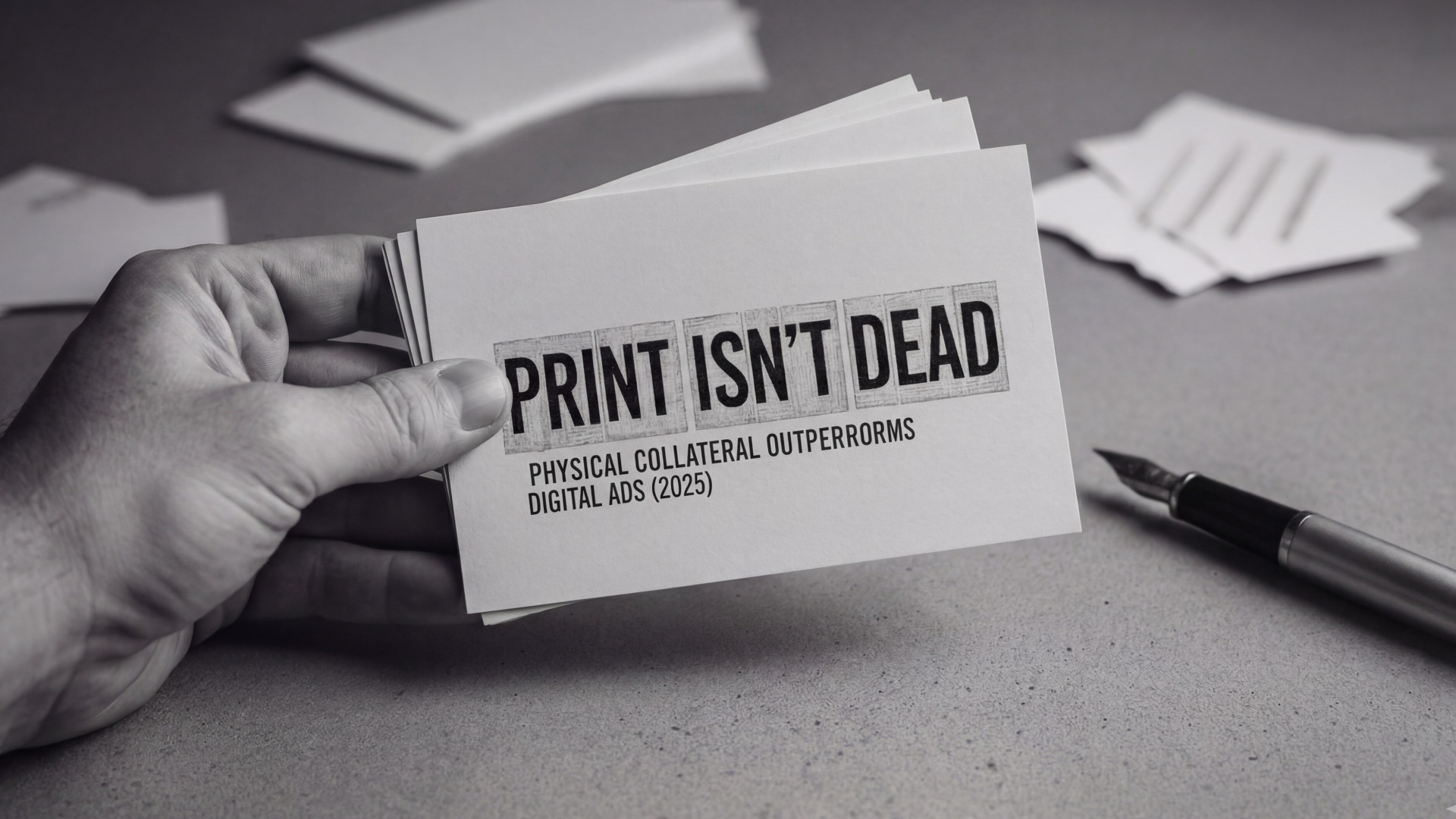
In 2025, marketers are witnessing an unexpected change. Traditional marketing methods like direct mail, brochures, flyers, and print advertisements are outpacing digital advertising. As digital advertising becomes oversaturated, overlooked, and filtered out, physical marketing is attracting interest, gaining credibility, and achieving impressive outcomes
What was once considered old-fashioned is now delivering better results, higher trust, and stronger returns than online advertising.
Our elders are always recommended to send letters, print coasters, and stickers on festivals and other occasions, but in the past few years, people have been sending online wishes at every occasion. Even a marriage invitation card is now turned into a digital PDF. Yeah, I know it saves money, time, and nature, but something needs to never change its core memory that we preserve. All parents of the '90s have their own Marriage album, but the current generation does not.
People scroll down ads in these fast scrolling words, even if the ad does not appear against the grain of algorithms, so people never know your brand exists. And here, the print media is winning every generation that has passed in numerous ways. Over the decades, print quality has improved; the print is what you keep remembering for years. Experiment with your design, packaging materials, texture, size, shape, etc. According to the market research in 2025, people are turning back to the printing media from digital running ads.
Direct mail, print ads, brochures, and tangible material are delivering results that make digital advertising look downright antiquated. The numbers don’t just suggest a trend; they reveal a seismic shift in how consumers engage with brands.
Digital advertising is facing its biggest challenge yet: a collapse of consumer trust.
Years of:
It has created widespread skepticism. Consumers increasingly view digital ads as intrusive, unreliable, and manipulative.
Social media ads, in particular, suffer from low credibility. Many users scroll past them instinctively or block them entirely. When trust erodes, performance follows.
Print media, on the other hand, operates in a more controlled, transparent environment. Newspaper, magazines, and direct mail carry an implicit credibility that digital platforms struggle to match.
By 2025, consumers will be overwhelmed by screens.
Daily exposure includes:
The Constant beverage has led to digital fatigue, a state where users actively avoid marketing messages rather than engage with them.
Ad blockers, unsubscribers, muted brands, and declining click-through rates are symptoms of this fatigue. Digital advertising has reached saturation.
That means physical marketing works better even for GEN Z.
Much Higher ROI( Return on Investment)
Physical marketing doesn't just get attention, it makes more money.$42 return for every $1 spent on direct mail. Direct mail gives 161%ROI, higher than any digital channel. The letter gives only 112% ROI, Email gives 93% ROI, and Online display ads give just 16% ROI. The difference is big enough to change entire marketing budgets.
In a world where the average person encounters between 6,000 and 10,000 ads daily, attention has become the scarcest resource. Digital ads lose this battle spectacularly. Physical collateral commands attention in ways that digital simply cannot match.
Direct mail delivers a 91% open rate, while email struggles to reach 20 to 30%. More importantly, 71 % of people read their direct mail the day it arrives. A direct mail piece holds someone’s attention for 132 seconds on average, compared to a mere 13.8 seconds for a television ad. The average print advertisement is viewed for about 2.2 seconds by 75% of readers, while digital ads are viewed for less than half as long by fewer than half the number of consumers.
The attention translates directly into memory. Brand recall for print ads reaches 77% compared to just 46% for digital ads. Physical ads require 21% less cognitive effort to process, leaving a stronger emotional impression that lingers longer in memory. Print marketing boasts a 70 to 80% higher recall rate than digital advertising, and consumers are 70% more likely to remember a brand they have seen in print compared to digital.
Seventy percent of consumers feel that print brochures, wedding cards, gift cards, ad campaigns, and direct mail are more personal than digital communication. This perception matters tremendously in an era when personalization has become a marketing buzzword often disconnected from genuine human connection. Physical print represents effort, intention, and investment. It can’t be sent with a single click to millions. Its very existence suggests the sender values the recipient enough to invest in something tangible.
The physical creates a sensory experience that digital cannot replicate. The weight of quality cannot replicate, the texture of a finish, the visual impact of professional printing; these elements combine to create an impression that resonates on levels beyond the purely informational. Approximately 42.2 percent of direct mail recipients either read or scan the mail they receive, a level of engagement that digital marketers would celebrate wildly.
The power of Integration :
Although physical collateral is surpassing digital ads in direct comparisons, the real effectiveness arises when marketers strategically integrate both channels. Online campaigns increase in effectiveness by 400% when integrating print and digital ads. Response rate increases to 27% when email is combined with direct mail. Marketing campaigns that combine direct mail with digital media experience a 118% increase in response rate.
The combined method enables every medium to utilize its advantages. Physical collateral cuts through the clutter and builds trust and recognition. Digital platforms offer quick access, engagement, and straightforward routes to purchase. In collaboration, they produce a synergy that neither could attain independently.
