
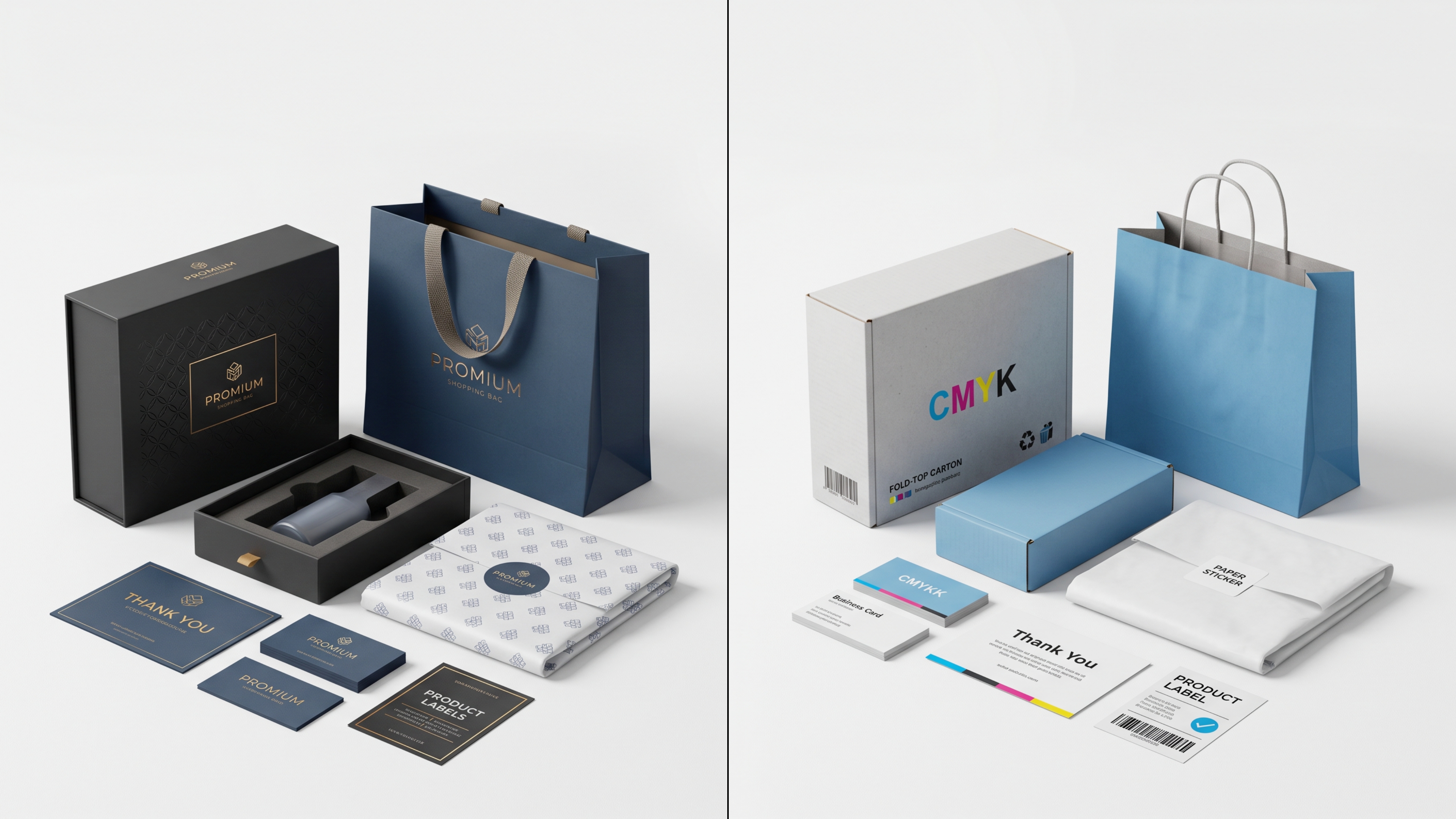
Take a trip to any supermarket in Mumbai, Ahmedabad or Rajkot and you will notice something interesting: two almost same products lying side by side and their price tag is vastly different – just because of the way they are packaged. One box is full of luxurious tactileity, almost as if it's too expensive to touch. The other is thin, shiny, dismembered. They have the same product in them. To the brain of the customer, there's only one story in the packaging.
This is the true arena of today's retail battle between premium packaging and budget packaging, and where a brand decides on which side of the fence they will stand will impact on the value customers see and the customer loyalty they achieve. Let's dissect the two and explain why this is a decision that should be given more thought than most businesses.
Premium packaging is not just about investing more in the packaging materials. It's a conscious design approach that comes down to texture, structure, print finish and unboxing experience. Consider rigid boxes, soft touch lamination, embossed logos, magnetic closures and custom inserts that hold the product. All elements are designed to draw the attention of the customer and make him feel that the product inside is worth the money.
Budget packaging focuses, however, on the cost efficiency and speed of the market. Functional, but forgettable: Simple carton, standard printing, minimal finishing. There's nothing wrong with this approach – it works well for commodity products, bulk FMCG products or even a brand that is driven solely by price. The issue is that when a brand desires to have a premium impression, some of their packages seem like a cheap player.
Creating packaging designs that affect consumer perception.Designing packaging that influences the consumer's perception.
The fact that packaging design impact is not really cosmetic, but psychological, is something that the majority of business owners underestimate. Research on consumer behavior has repeatedly been conducted that shows that an opinion regarding the quality of a product can be formed in seconds after viewing the packaging, usually before reading the label. These are subconscious cues of quality, trust, and craftsmanship: A heavier box, a matte finish and a well-chosen color palette.
That is why two products that are basically the same can cost as much as three times as much as each other. One is invested in design, and it conveys the idea that "we care about every detail", the other just says, “here's the product, take it or leave it.” This perception gap directly affects shelf performance and repeat purchases in a range of categories including, among them, skincare, spices, tea and specialty foods, all of which are strong players in product packaging India.
Packaging becomes the first physical interaction that a consumer has with a brand prior to making a purchase decision. No one is selling anything, no website tour, no story from the founders, no anything but the box on the shelf. Packaging is one of the most effective and least utilized marketing tools for today's Indian companies, making it a powerful branding tool.
Whether a company intends to do them or not, everything in that box – whether it's typography, color palette, logo placement, tone of the copy – is doing some type of branding. This real estate is used purposefully by premium packaging: the use of consistent brand colors, the logo position, finishes which reinforce the brand's personality (rustic kraft for an organic brand, glossy foil for a luxury brand). On the other hand, budget packaging tends to consider the box as an afterthought and slowly loses brand recall over time.
Even products that are common commodities like Adani Spices and Neelam Tea look great when they are packaged well; it is a testament to the fact that even common products in India can get a lot of value added with design investment.
One of the most widely held erroneous beliefs is that premium packaging equals "more expensive" (without any qualifiers). In practice, the cost discussion is not as straightforward as it may seem:
Premium options (rigid board, specialty coatings, foil stamping) will increase per carton, sometimes by 2-4 times the basic carton.
When the packaging is well designed and the premium packaging cost is justified by perceived value uplift, the price difference can be easily overcome by the premium packaging cost and 15-30% of price premium can be achieved.
Return on shelf visibility: Differentiated packaging decreases the need to heavily discount the product or spend on promotions to attract people.
The unboxing experience can lead to repeat purchases and word-of-mouth referrals, reducing long-term acquisition costs.
When it comes to budget packaging, the equation is reversed. Lower upfront cost is appealing for high volume categories with low margins, but in doing so the brand loses differentiation and, in the end, the price competition can create a race of models that have equal margins, which eventually leads to a situation where the margins are squeezed thin.
How consumers decide how to buy products is the key.
Finally, the premium versus the budget choice needs to be worked out the other way: from the consumers' behaviour in the given product category. Here are a couple of patterns to note:
High-end packaging works exceptionally well in the gift and festive categories (sweets, dry fruits, personal care) as such purchase is an emotional one and the value perception is more important than real price.
Daily essentials and staples (grains, basic groceries) have more price sensitivity and customers are more likely to value simple and honest packaging more than elaborate packaging.
D2C brands and new brands will almost invariably get great packaging early on as that's their only indication of credibility when competing with established brands.
Impulse purchase categories (snacks, beverages) are extremely dependent on shelf standout and therefore design and colour psychology is more important than material costs.
It's much more useful for you to know your product's place in this behavioural map than just ask "should we go premium or budget?".
It seems that it is scrolled over.
It isn't a one-size-fits-all situation; the best response is contingent on the category, price positioning, and the narrative a brand would like to convey. However, in most markets, as long as a brand aims to be perceived as premium, its packaging should be leading rather than following that impression. If the box tells the customer otherwise, they will have little faith in the quality of the product.
That's where the expertise of an experienced packaging design agency comes in handy. A quality agency doesn't just tell you to make a box pretty, it also takes the time to research the target, category standards and competitor shelf presence before suggesting a direction. It's a balance between looks and production-feasibility, and not spending too much on the packaging, or spending too little on the packaging.
This is what we do at Asense Branding: use real consumer insight, not just visual trends to guide every packaging project. It doesn't matter if the brand requires a full, premium packaging makeover or if the package design is more of a modular, budget-friendly approach that still ensures the product gets a spot on the shelf, the end result is the same packaging that sells.
Premium packaging is not in opposition to budget packaging; instead, it's a difference in means that will serve different ends. Smart brands don't fall into a pattern, choosing one or the other out of habit; they do so on purpose because they have data to back them up that customers do respond to one or the other. In a market as varied and rapidly expanding as India's, this quiet choice – premium or budget – can mean the difference between a product being picked up and scrolled past.
