
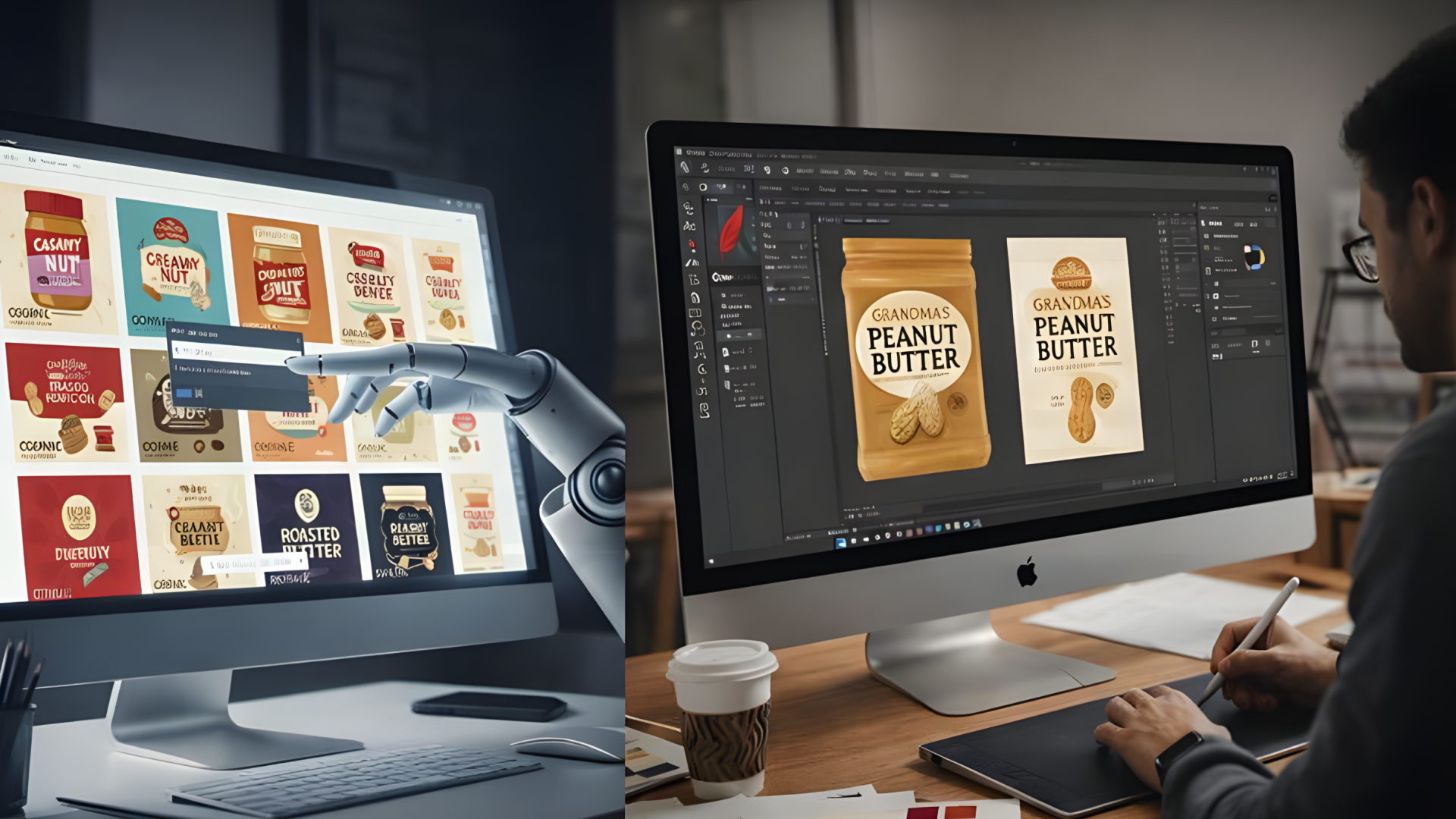
Packaging used to be instinct-led. Creative directors relied on mood boards, designers trusted their eye, brand teams debated fonts and finishes in boardrooms for weeks. And well… a design would go to print based on experience, intuition, and market observation.
Today, something new sits at that table.
Data.
More specifically, AI packaging design.
Artificial intelligence is actively influencing how brands conceptualize, test, and refine their packaging before a single prototype is produced. But the real question isn’t whether brands are using AI, because they so are.
The real question is:
Is it reliable?
The pressure on packaging to perform its part while even trying to justify the price and the premiumness of the product has never been higher than now. On retail shelves, products have less than three seconds to capture attention. In e-commerce, packaging competes in thumbnail-sized visuals and in D2C brands, unboxing moments are shared on social media before the product is even used. In that environment, risk is expensive.
This is where artificial intelligence in branding begins to make sense. AI allows brands to simulate shelf environments, analyze competitor color palettes, predict attention heatmaps, and test structural durability; all of it before the physical production is even given a thought.
Instead of designing one concept and hoping it performs, brands can generate dozens of visual directions with layout variations, typography experiments, material finishes, and check sustainability simulations within minutes using
AI design tools. Doing all this reduces uncertainty, and in a market where packaging mistakes can cost millions in inventory and logistics, reducing uncertainty is a powerful move.
Brands aren’t handing over full creative control to machines. The smart ones are using AI in very specific ways:
AI can generate early-stage visual ideas at incredible speed. Designers use these outputs as starting points and that helps teams move from blank canvas to directional clarity quite quickly.
AI can scan entire product categories and identify common visual themes. This helps brands understand current packaging design trends and more importantly they realise where white space exists.
AI models can simulate packaging performance during shipping. Brands are reducing breakage, material waste, and returns by predicting weaknesses before physical production.
As eco-conscious packaging is non-negotiable, and AI helps brands test alternative materials digitally, thus reducing prototype waste and boosting innovation.
All of this isn’t creative replacement; it’s intelligent augmentation.
The Reliability Question
Now let’s address the tension. Is AI reliable?
From a technical standpoint, Yes, it is.
AI is incredibly reliable at pattern recognition. It excels at identifying what has worked before and predicts outcomes based on existing data.
But here’s the limitation. Brands aren’t built only on patterns. They’re built on emotions, aspirations, and cultural timing. AI can tell you that minimalist beige packaging performs well in skincare but it cannot tell you when the market is emotionally ready for maximalism again. It cannot anticipate cultural shifts before they happen.
This is why some AI-generated packaging looks polished… but there’s no differentiation. When brands rely purely on AI outputs, they risk blending into the very trends they’re trying to capitalize on.
Reliability depends on usage. AI is reliable as a tool but it is unreliable as a creative compass.
The Risk of Homogenization
There’s another subtle danger in over-reliance on AI packaging design.
If every brand trains models on similar sets of data and gets inspired from the same trending aesthetics, then the visual identities start to feel distorted in a familiar way. Suddenly, every clean beauty brand would look the same, every tech gadget box would feel identical and every eco-friendly product would be using the same earthy palette.
This is where using a strategy becomes utmost important. Packaging more about positioning than aesthetics. Without strong brand foundations, AI becomes a shortcut to similarity. With strong brand foundations, AI becomes a tool for amplification.
The brands that are truly standing out right now aren’t replacing designers, they’re upgrading them. They use AI design tools to explore more boldly. They use data insights to support brave creative decisions and they validate risks instead of avoiding them. Think of AI as a strategist’s assistant which is fast, analytical, and precise.
But the brand voice? The emotional hook? The narrative behind the packaging?
That still belongs to humans. Because packaging is not just visual communication; it is psychological communication.
Absolutely. The future of packaging will be smarter, faster, and more predictive, all due to AI.
We will see:
But here’s what won’t change.
Brands that understand their identity will outperform the others that follow algorithms as a way of branding.
Technology accelerates, but the differentiation that makes your brand recall strong still comes from clarity.
For companies evaluating whether to integrate artificial intelligence in branding, the question shouldn’t be “Should we use AI?”
It should be:
“How do we use AI without losing ourselves?”
Start with brand strategy by defining your audience. Then clarify your positioning and later allow AI to stress-test, optimize, and refine. AI reduces waste, shortens development cycles, and enhances decision-making when you use it strategically. However, when used incorrectly it just creates mediocrity that looks put together and polished.
So, Is It Reliable?
Yes, when guided. No, when blindly followed.
The brands that will lead in the next decade are the ones that collaborate with AI rather than resisting it or surrendering to it entirely. Because in the end, packaging doesn’t win because it was generated faster, it wins because it makes someone pause, and pause is still a human reaction.
